


In March 2025, a former Colombian soldier arrived in Bosaso, on the Gulf of Aden coast of Puntland, and spent approximately ten days in a bunker at what he described as a military base. Around forty other Colombian contractors were there with him. His destination was Sudan. According to the account he later gave Human Rights Watch, his journey continued through the United Arab Emirates and Chad before reaching Nyala, the capital of South Darfur. He had crossed continents to enter a war whose civilians were struggling to escape it, passing through a system of recruitment, military facilities, transportation and border connections that made his arrival possible. While Sudanese families were being driven from their homes, foreign military labor was moving toward the territory from which those families had fled.[1]
His journey reveals something about the organization of contemporary warfare that is difficult to see when the conflict is examined only through the movements of armies inside Sudan. A port city in Puntland, an Emirati connection, a route through Chad and an airfield in Darfur appeared within the same account because military personnel can now be recruited, financed and transported through institutions operating across several countries. Each location possesses its own political history, and the organizations involved do not necessarily share one command structure. But the ability to connect them gives armed groups access to resources they could not obtain through their own domestic institutions alone. Behind the apparently separate worlds of private security, international employment, aviation and regional diplomacy lies the capacity to deliver military force into a country whose population bears the consequences of its deployment.
Sudan’s present catastrophe did not begin with the arrival of foreign contractors. The country entered the war with an economic and political order shaped by colonial extraction, unequal regional development, military domination and the concentration of productive wealth within institutions removed from popular control. Part I of this series examined Sudan’s war within that longer history of imperialism and revolutionary resistance, tracing the contradictions through which a country rich in agricultural land, mineral resources and strategic geography became a battleground between armed organizations whose political authority developed through the dispossession of ordinary people. The revolution beginning in 2018 challenged that order, bringing workers, professionals, students and neighborhood organizations into a struggle against Omar al-Bashir’s dictatorship. His removal in April 2019 was a historic victory, but the military and commercial structures through which the ruling class exercised power remained largely intact. The Sudanese Armed Forces and Rapid Support Forces retained their weapons, economic interests and capacity to intervene against civilian authority, eventually turning against one another in a war whose destruction now extends across the country.
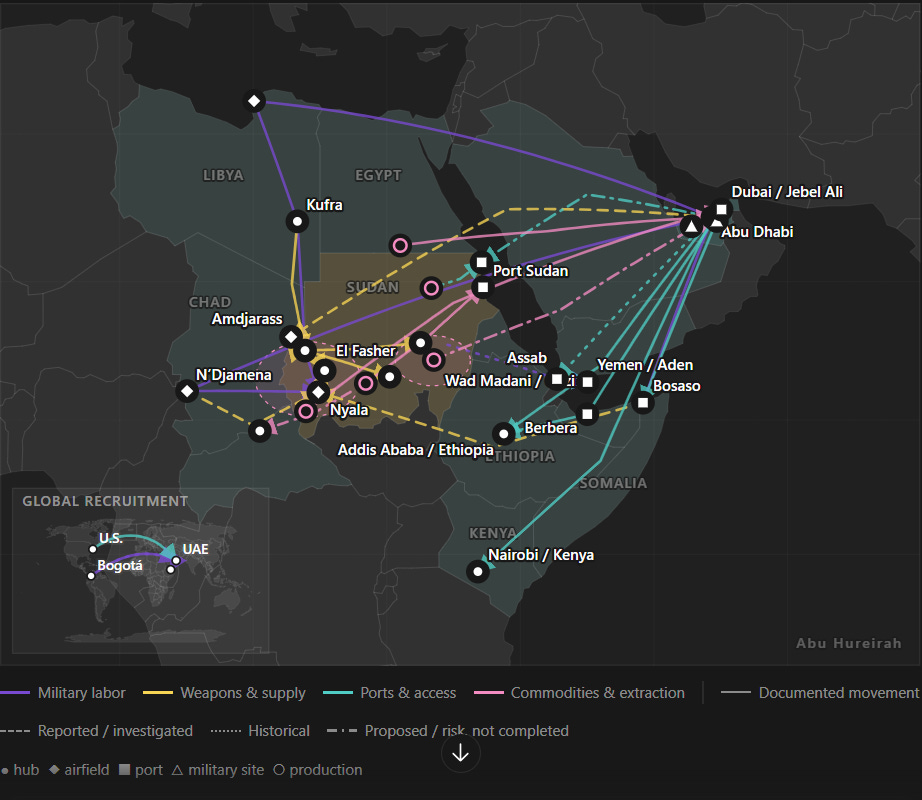
To access the interactive version of this map of the UAE network click here
This investigation concerns the material relationships through which that war is sustained. It follows the companies recruiting military labor, the airfields and border routes through which personnel and equipment move, the international systems purchasing Sudanese commodities, and the commercial infrastructure through which regional powers pursue access to valuable territory. These relationships belong to a wider political economy in which the control of land becomes control over resources, resources become purchasing power, and purchasing power sustains the armed institutions defending the conditions of extraction. The violence occurring inside Sudan cannot be separated from the markets and logistical networks operating beyond its borders, but those external relationships do not eliminate the responsibility of Sudanese commanders or the ruling classes that created the armed organizations now fighting over the state.
The UAE’s position within this system can be understood as an empire of access: a dispersed structure of commercial concessions, military partnerships, financial intermediaries, logistical facilities and political relationships through which a regional power can influence productive territory without directly governing it. A port concession in one country, an airfield in another, a commercial relationship with an armed organization and a market for valuable commodities can become strategically useful because they provide access to different stages of production and movement. The system does not require one government to administer every location or one company to control every transaction. It operates through overlapping interests, negotiated relationships and unequal resources, with different participants exercising forms of authority that may reinforce one another without becoming identical. Its fragmentation can make the network durable, but it also creates vulnerabilities because local governments can alter agreements, armed partners can change alliances and communities can organize against the arrangements imposed upon them.
The evidence must be distinguished across three related but different levels. Investigations of recruitment, military procurement and transport provide documented findings or strongly supported assessments concerning assistance to armed organizations. Commercial concessions, ports and airfields show infrastructure whose ordinary civilian functions can coexist with strategic or dual-use possibilities, although the military role of a particular facility must be established rather than assumed. The destruction of agricultural livelihoods, forced displacement and dependence upon reconstruction finance create another category: structural risks concerning future dispossession, where the danger can be analyzed without claiming that every possible acquisition has already occurred. A weapon traced through export records and a warning about land concentration after the war are not equivalent findings. Their relationship belongs to the political economy of the conflict, but their evidentiary status remains different.
The term counterrevolution describes the political function of the system where external military and economic support strengthens armed institutions standing against the demand for civilian and democratic power expressed during and after Sudan’s revolution. The RSF and the army participated in the destruction of the civilian transition, preserving the authority of military organizations whose economic interests depended upon the continuation of power outside popular control. Foreign support can help sustain that order, but a commercial investor seeking profitable access to a port does not necessarily share the motives of an official authorizing military assistance. Deliberate support for armed forces, commercial opportunism and geopolitical influence operate through different decisions. Their convergence can nevertheless strengthen the material foundations of a political order whose survival depends upon denying ordinary Sudanese authority over their own country.
The central issue is therefore not simply whether a foreign state possesses a military base or whether a company invests in an African port. It is how the different institutions of military and economic power become connected, whose interests those connections serve and whether the people whose land and labor make them valuable possess any ability to determine their terms. Sudan’s counterrevolution has a territorial economy. Violence removes populations from places where they live and work, armed control determines who may occupy those places, and external markets provide destinations for the resources extracted from them. The danger reaches beyond the battlefield into the arrangements that could determine what happens after the fighting changes or ends. A village may remain on the map after its inhabitants have been scattered across borders, while the land beneath it acquires new economic value for people whose wealth depends upon the absence of those inhabitants.
The Internationalization of Violence and the Market for Military Labor
I. Colombian Mercenaries and the Outsourcing of Counterrevolution
The Colombian contractor did not enter Sudan’s war through a Sudanese recruitment office. Investigations by La Silla Vacía traced recruitment to International Services Agency, known as A4SI, documenting accounts from former soldiers who believed they had accepted work protecting oil infrastructure in the United Arab Emirates. Some said they learned of their actual destination only after leaving Colombia, when the journey had already placed them within a recruitment system whose financial and logistical arrangements made withdrawal increasingly difficult. The outlet reported promised payments of approximately $2,600 for soldiers and $3,400 for sergeants, alongside testimony from recruits whose debts influenced their decisions to continue. These accounts include allegations of deception within particular employment arrangements, but they also expose the wider conditions through which military labor becomes available for purchase. Veterans trained through one country’s prolonged internal conflict can be recruited into another country’s war because their military experience has acquired a commercial value beyond the society in which it developed.[2]
The relationship between economic vulnerability and armed labor is fundamental to this system. A former soldier may possess extensive combat experience without obtaining stable civilian employment, allowing recruitment companies to present dangerous deployments abroad as opportunities for financial security. The offered salary can become more persuasive where debts have accumulated and the prospects of alternative work appear limited. This does not remove the responsibility of individual fighters for the violence they subsequently commit, nor does it mean every person entering the recruitment process was deceived. It shows how the international market for military labor can organize the consequences of economic insecurity into a supply of experienced personnel available to organizations willing to pay for their services. The skills were developed through violence in Colombia, but their eventual use was determined by employers and military institutions operating elsewhere.
The separation between those purchasing military capacity and those carrying the weapons changes how the costs of intervention are distributed. A wealthy regional power can obtain experienced fighters without recruiting them entirely from its own population, while companies operating through employment contracts provide the administrative machinery needed to move those fighters across borders. The political leadership benefiting from the deployment can remain geographically removed from the immediate fighting, and the contractor’s legal relationship may be described through ordinary commercial language even though the work ultimately strengthens an armed organization. The people of Darfur encounter the result in the form of additional military capacity entering a war already characterized by widespread displacement and violence against civilians.
Military labor is not an ordinary commodity simply because contracts and salaries are used to purchase it. The service being acquired is the capacity to exercise organized force, and its deployment takes place within political conflicts whose consequences extend far beyond the individuals receiving payment. A contractor may be recruited by one company, transported by another and supplied to an armed organization whose command structure is not the same as that of the recruiter. The separation of those functions makes responsibility more difficult to identify, but it does not eliminate the political significance of the operation. What begins as employment abroad can become part of a system sustaining military domination over populations that never consented to the deployment.
The route from Colombia to Sudan is consequently a relationship between different forms of power and vulnerability. Colombian veterans possess military skills developed through a prolonged conflict, recruitment companies possess access to contracts and employment networks, and the organizations receiving the fighters possess objectives within Sudan’s war. The money required to assemble those capacities moves through institutions outside the territories where the violence occurs. The resulting division of labor allows the economic insecurity of one society to become a resource used in the destruction of another, revealing how the international organization of war can connect people whose lives are otherwise separated by geography and political history.
II. The Corporate Machinery of Recruitment and Payment
The employer network reached into Abu Dhabi. In November 2025, The Sentry reported business relationships between Mohamed Hamdan Alzaabi, owner of Global Security Services Group, and Ahmed Mohamed Al Humairi, secretary general of the UAE’s Presidential Court. It also described an arrangement between GSSG and A4SI to supply former Colombian soldiers to the RSF, drawing upon documents obtained by Colombian journalists. The relationships raise serious questions about the degree of state knowledge and institutional support involved in recruitment and deployment. A business connection with a senior government official does not establish that the official personally authorized every movement of personnel, and the distinction must remain intact. The UAE has rejected allegations that it supplies mercenaries to the RSF.[3]
Human Rights Watch’s May 2026 investigation added evidence concerning the facilities through which contractors moved before their deployment. Drawing upon interviews, company records and geolocated material, it examined the presence of personnel at government-linked military sites in the Emirates, including Ghiyathi and Al Wathba. The report traced contractual relationships involving A4SI and GSSG, examined assembly and training, and connected those activities to onward movement toward the RSF. Human Rights Watch assessed the deployment as appearing to constitute a UAE state-backed operation. Its conclusion rested upon converging evidence concerning facilities and organizational relationships rather than a publicly identified order signed by a particular official. Access to regulated military installations, however, changes the character of the inquiry. It places the recruitment process within infrastructure whose use ordinarily depends upon institutional authorization.[1]
The distinction between a private company and the state becomes increasingly difficult to sustain when employment arrangements pass through government-linked military facilities. Recruitment may be performed commercially, but the process can depend upon infrastructure and permissions unavailable to an ordinary private business acting entirely independently. The investigation therefore concerns more than whether companies share directors or maintain business relationships with politically connected individuals. It asks how personnel were assembled, trained, paid and transported, and which institutions made those activities possible. A company registration cannot answer those questions by itself, but neither can the formal description of an employment contract explain away the movement of trained fighters through military installations.
The administrative network was able to adapt as particular participants came under scrutiny. In April 2026, the United States Treasury sanctioned additional actors connected to Colombian recruitment, identifying Panama-registered Talent Bridge, formerly Global Staffing, as an intermediary handling contracts and money between A4SI and the hiring company. Treasury also identified Fénix Human Resources as a replacement agency established by A4SI’s founders. An earlier round of designations in December 2025 had named further participants, including the separate recruiting firm Global Qowa Al-Basheria. These findings concern different roles in the organization of recruitment and payment rather than one company exercising command over every operation. They demonstrate how an international procurement system can reorganize its corporate identities without necessarily abandoning the market it serves.[4][9]
The separation of functions is itself part of the business. Recruitment can take place in one country, contracts can be administered through another, payments can be processed by an intermediary and transport can be arranged through organizations operating across several jurisdictions. Each stage can be described as a separate commercial service, leaving the relationship between the companies and the final military deployment less visible than the transactions themselves. At the end of that process stands a contractor with a weapon in Darfur, while behind him stand institutions capable of explaining their participation through the ordinary language of employment, security services or logistics. The industrialization of proxy warfare consists partly in this capacity to procure violence through a dispersed commercial system while placing distance between its organizers and its immediate consequences.
Treasury designations remain administrative findings rather than criminal convictions of every person or business named within them. The conduct and knowledge of particular participants must be established through evidence, especially where a company may have performed only one function within a larger operation. But accountability cannot be reduced to the narrow description of that function if the service materially contributed to the deployment of armed personnel. Contracts, payments, facility access and transport records become politically important because they can establish how companies participated in the procurement process, who controlled the relevant decisions and what the organizations involved knew about the destination of the fighters. Responsibility has to be traced across the commercial separation of labor rather than allowed to disappear inside it.
III. Yemen, Assab, and the Earlier Circulation of Military Labor
The Emirati use of Colombian military labor did not begin with Sudan’s present war. In November 2015, The New York Times reported the deployment of hundreds of Colombian mercenaries to Yemen, documenting an established practice of recruiting Latin American veterans for military operations serving Emirati interests. The earlier deployment matters because the present market did not appear suddenly when foreign contractors were reported entering Darfur. Military experience accumulated through Colombia’s internal conflict had already become available for use elsewhere, with recruitment organized through salaries rather than the direct mobilization of Emirati citizens. The state purchasing the military service and the personnel performing it occupied different positions within an international hierarchy of resources and political power.[5]
The Sudanese part of this history initially moved in the opposite direction. Before foreign Colombian contractors were brought into Sudan, Sudanese troops were deployed into the Yemen war through arrangements involving Saudi Arabia and the UAE. Associated Press reporting on the Emirati base at Assab, on Eritrea’s Red Sea coast, described infrastructure used to move Sudanese soldiers and heavy weapons into Yemen. An African port and airfield had become part of the logistical system sustaining military operations across the water. Sudanese military labor was being employed in another country’s conflict, supported by facilities located in a third territory whose government had its own relationship with the Emirates.[6]
Assab demonstrates how access to infrastructure can extend military influence beyond the territory of the power operating it. Beginning in 2015, the Emirates developed the port and airstrip to support operations connected to Yemen, making the African coast part of the military geography of an intervention on the Arabian Peninsula. By February 2021, Associated Press analysis of satellite imagery showed equipment removal and the dismantling of parts of the facility. The change was part of the base’s history, reflecting a recalibration of direct military involvement rather than erasing its earlier role. Infrastructure could be expanded when intervention required it and reduced when political priorities changed, while the networks of military relationships developed through its use did not necessarily disappear.
The political economy of military labor connects these interventions across time without making them identical. Colombian veterans were reported entering Yemen in 2015, Sudanese troops were moved through Emirati infrastructure into that war, and later Colombian contractors were connected to Sudan through recruitment and transport networks. The direction of movement changed, but the underlying practice remained recognizable. A wealthy regional power could obtain military capacity from people whose employment and political circumstances differed from those of its own population, and infrastructure distributed across the region could make that capacity available where intervention was considered useful.
The Emirates’ relationships with armed organizations in southern Yemen also demonstrate how military influence can continue after a reduction in direct troop presence. Research by the Sana’a Center describes the cultivation of local partners and the recalibration of Emirati involvement following the withdrawal of much of its direct force in 2019. The armed groups supported through those arrangements possessed political ambitions and rivalries of their own, including tensions with other Yemeni forces and with Saudi priorities. Their interests could overlap with those of Abu Dhabi without becoming indistinguishable from them. External support strengthened particular organizations, but the relationships through which it operated were negotiated within conflicts whose histories and local actors predated or exceeded the intervention.[27]
The significance of this history is not that Sudan and Yemen belonged to one predetermined plan. It is that forms of military outsourcing and regional logistical access had already been developed before the present Sudanese war. The infrastructure and commercial practices capable of moving armed personnel between countries were not inventions of the RSF’s current conflict. They belonged to a wider system in which military labor could be purchased, transported and deployed beyond the formal borders of the states financing it. Sudan’s war became another location within that system, with devastating consequences for populations whose land and homes were already exposed to armed domination.
IV. Libya, Chad, and the Armed Economies of the Sahel
The Colombian recruitment network represents only one part of the military labor and logistical systems surrounding Sudan. The borderlands connecting Chad, Libya and Sudan contain armed economies shaped by years of conflict, where local commanders and brokers trade access to weapons, vehicles, fuel and transport routes. Fighters move between struggles, and the relationships enabling movement can remain valuable even as political alliances change. A 2026 United Nations Panel of Experts report on Libya described the Subul al-Salam battalion’s consolidation of supply chains supporting RSF-affiliated forces, with the tacit approval of Khalifa Haftar’s Libyan Arab Armed Forces. The report also identified Libyan and Chadian brokers diverting portions of consignments for resale elsewhere. These findings describe networks with interests of their own, not evidence that every fighter or intermediary operating across the Sahel follows one foreign command.[7]
The endurance of these networks depends partly upon the independence of the people controlling them. A sponsor seeking to move supplies across southeastern Libya does not need to construct every route or recruit every intermediary from the beginning. Existing armed organizations may already possess the vehicles, contacts and territorial knowledge required to move goods through areas where ordinary commercial transport has become dangerous or politically constrained. Brokers can sell their services to new customers, commanders can bargain for payment or equipment, and local armed groups can use relationships with foreign partners to strengthen their position within regional rivalries. The resulting system is not perfectly centralized, but its fragmentation allows transport and procurement to continue through changing political conditions.
One Colombian recruit’s journey became visible through evidence that placed him on the Libyan route. Bellingcat examined documents and social media material associated with Christian Lombana Moncayo, comparing them with travel records and footage posted online. Investigators geolocated material from November 2024 to a road approximately 110 kilometers north of Al-Jawf in southeastern Libya, corroborating a segment of the transit route described by contractors. The finding did not reconstruct every stage of every recruit’s movement, but it placed a Colombian veteran within a landscape where armed networks had long traded access to territory and transport. A road crossing the desert had become part of the international organization of military labor.[8]
The international market for armed services therefore depends upon capacities developed through different conflicts. Colombian veterans supply military experience, regional brokers provide movement through contested territory, and armed organizations receiving the personnel acquire additional capabilities for their operations. Money connects the participants without requiring them to possess identical political aims. The contractor seeking employment, the commander controlling a route and the organization purchasing military capacity may cooperate because the transaction serves each of their immediate interests. Their cooperation can nevertheless produce consequences far beyond those interests, including the reinforcement of a military force already responsible for atrocities against Sudanese civilians.
This network of movement is politically different from direct colonial occupation, but it can serve the projection of power across borders. Wealthy sponsors obtain military capabilities through relationships with actors whose livelihoods and authority have been shaped by conflict, while the populations receiving those capabilities remain exposed to force they did not authorize. The system draws upon insecurity in one region to deepen insecurity in another. Its commercial organization may allow individual participants to explain their roles narrowly, but the broader result is an international division of military labor capable of sustaining violence across societies already devastated by war.
The Air Bridge and the Material Organization of Counterrevolution
V. Amdjarass: Humanitarian Infrastructure and the Question of Military Supply
Amdjarass, in northeastern Chad, became one of the most contested locations in the networks surrounding Sudan’s war. The UAE opened a field hospital there in July 2023, presenting the operation as part of its humanitarian response to people fleeing the conflict. The hospital treated patients, and the existence of genuine medical assistance cannot be dismissed because other cargo movements became the subject of investigation. But the airfield’s location also raised questions. Amdjarass lay near routes toward Darfur, while the largest concentrations of Sudanese refugees were located farther south along the border. Location alone could not establish the military purpose of a flight, but it made the scale of aviation activity and the development of facilities matters requiring serious examination.
Investigators documented repeated flights through Amdjarass, although their counts measured different periods and datasets. The Sudan Conflict Observatory identified 32 flights between June 2023 and May 2024 within one defined investigation, while Reuters separately counted at least 86 flights through a broader examination of aviation activity. The findings overlap and cannot simply be added together without double-counting some movements. Their importance lies in the sustained use of the airfield and the relationships that could be traced through aircraft registrations, flight histories, facilities and witness accounts. A flight record can establish that an aircraft moved between locations, but the identification of its cargo requires additional evidence.[10][11]
Satellite imagery examined by investigators showed runway improvements, expanding hangars, aircraft shelters and fuel storage. Some of the carriers appeared in earlier United Nations scrutiny of transfers to forces associated with Khalifa Haftar in Libya, while witnesses described cargo being unloaded under escort and moved overland toward the Sudanese border. Investigators also examined evidence concerning possible armed drone operations. These observations raised serious questions about the airfield’s strategic function, especially when considered together, but they did not establish the contents of every arriving aircraft. In June 2023, reporting concerning a flight stopped in Entebbe described weapons concealed within cargo declared as humanitarian assistance. That incident challenged the assumption that cargo declarations necessarily described what an aircraft carried, without establishing the flight’s ultimate destination or making every humanitarian delivery through Chad a weapons shipment.[10][12]
The 2024 United Nations Panel of Experts provided a more specific assessment. In paragraphs 39 through 43 of S/2024/65, it documented an expansion in RSF firepower and judged allegations of weapons transfers from the UAE through Amdjarass credible. Its findings drew upon accounts of heavy aircraft, unloading operations and convoys moving through eastern Chad toward Zuruk and Darfur. The UAE denied the allegations and maintained that its flights transported humanitarian assistance. The Panel assessed a supply chain connecting external cargo movements to the military capacities of the RSF, although its findings did not amount to a manifest of every aircraft or a criminal judgment establishing the responsibility of particular pilots and officials.[13]
The later United Nations investigation covered a different period and produced a more limited finding concerning Amdjarass itself. In S/2025/239, the Panel stated that it could not confirm transfers of military materiel from the airfield during its subsequent investigative window. This did not withdraw the earlier assessment, just as the earlier assessment could not establish what occurred on every flight in the later period. The Panel’s paragraphs 94 through 104 also examined routes through eastern Chad, including Bir Mirgui, and verified nighttime aircraft landings at Nyala. The evidence had begun to describe a logistical system extending beyond one airfield whose operations could change in response to scrutiny and developments on the battlefield.[14]
The distinction between humanitarian activity and military supply is essential to the investigation because both questions concern identifiable actions rather than the presumed character of every institution operating at the facility. A medical team treating displaced people performs a different function from a procurement network transporting military equipment, even if both activities are alleged to use overlapping infrastructure. The existence of genuine humanitarian assistance does not resolve evidence concerning weapons transfers, while credible allegations of military supply do not make every patient or aid delivery fictitious. Accountability requires examining the records connecting specific aircraft, cargo and receiving organizations, rather than transforming either side’s general description into proof of every movement.
Amdjarass demonstrates how an airfield can become politically important through the relationship between its location, capacity and the routes available beyond it. Runway improvements and fuel storage increase the possibilities for aviation, while roads and border connections determine whether cargo can move onward. The same infrastructure can possess civilian and military value, and the presence of one use does not automatically establish another. But in a war where external assistance can alter the ability of armed organizations to continue fighting, the question of what moved through that infrastructure becomes inseparable from the conditions under which civilians in Darfur were being attacked and displaced.
VI. From Amdjarass to Nyala: The Changing Geography of Supply
The routes surrounding Sudan’s war did not remain confined to Amdjarass. Zuruk and other crossings connected eastern Chad with RSF-held positions in Darfur, while Bir Mirgui appeared in later United Nations mapping as a logistical hub. Nyala became an airfield inside territory controlled by the RSF, creating a possible destination for personnel and equipment arriving through external routes. Kufra in southeastern Libya offered another corridor through forces associated with Khalifa Haftar, whose relationships with the Emirates developed before the present Sudanese conflict. N’Djamena and Bosaso entered subsequent aviation and contractor reporting, placing different jurisdictions within an expanding geography of military movement.[14][7][15]
The locations performed different functions and operated under different authorities. A verified landing at Nyala does not establish what an aircraft previously carried through Bosaso, while a commercial agreement concerning a port does not automatically confer control over military movements through nearby infrastructure. But the existence of several possible routes can make the wider network more resilient. Where one crossing is disrupted, another may remain available; where a particular partner withdraws cooperation, intermediaries controlling other routes may continue providing services. The system’s usefulness lies partly in the ability to redirect movement without requiring the sponsor to exercise direct authority over every territory involved.
Reuters’ July 15, 2026 investigation reconstructed movements of Boeing aircraft through flight records, company documents, satellite imagery and video. Its account included an aircraft destroyed at Nyala on May 3, 2025, reporting 54 deaths, including 51 RSF personnel, and links to a UAE-based operator structure. These were Reuters’ reported identifications rather than independent proof that the Emirati government owned the aircraft or directed its final flight. The available evidence concerned operators, movements and relationships requiring further examination of the institutions controlling the aircraft and the purpose of its journey.[15]
A July 29 Reuters investigation reported on an unpublished draft United Nations Panel document examining movements between N’Djamena, Kufra, Bosaso and Nyala, including the transport of foreign personnel and military equipment. The draft provided evidence concerning the issues investigators were examining, but it was not an adopted Panel finding and should not be presented as one. The difference matters because a leaked investigative document can contain significant material without possessing the institutional status of a final report. Its findings must be attributed to the reporting and document from which they came, rather than converted into a completed United Nations judgment.[16]
A separate investigation by the United Nations Independent International Fact-Finding Mission, issued in September 2026 as A/HRC/63/23, examined weapons, fighters and external support networks through interviews, open-source material and expert consultations. Applying a reasonable-grounds standard, the Mission considered routes involving UAE-linked entities, Chad, southeastern Libya and Puntland, and reported evidence concerning equipment arriving at Nyala. Its findings added witness and technical material to the public record without identifying an individual state order authorizing every shipment. The report nevertheless strengthened the evidence that military support networks extended across several regional corridors rather than depending entirely upon one contested air bridge.[17]
The resulting picture is of a system capable of changing its routes as the political and military circumstances surrounding them change. A transport company may operate aircraft registered through one jurisdiction, an intermediary may negotiate access through another, and the final destination may be an airfield inside territory controlled by an armed organization. The different stages can become separated in public records even where they contribute to the same movement of personnel or equipment. Identifying who financed, authorized and received a particular shipment requires connecting those stages through documentary and witness evidence.
This is an important limit upon the claim that a single base or port controls the entire conflict. The geography of intervention is fragmented, and the relationships sustaining it may shift under pressure. But that fragmentation also makes the system harder to dismantle through action against one location alone. The institutions organizing military supply can search for alternative corridors as long as armed organizations possess access to financiers and intermediaries willing to provide the required services. The movement of violence becomes international even when the people living beneath the receiving force remain excluded from every decision that made the movement possible.
VII. Weapons, Export Licenses, and the Material Evidence of External Support
Weapons documented in Sudan provide another body of evidence concerning external support, but their histories cannot be reconstructed through the country of manufacture alone. A weapon may be produced in one state, sold to another, transferred through an intermediary and eventually used by a force whose operators were trained elsewhere. Human Rights Watch identified Serbian 120-millimeter thermobaric rounds in material connected to the RSF, using markings and export documents to trace a shipment to the UAE Armed Forces Joint Logistics Command under a contract involving ADASI. The records included restrictions on reexport, raising serious questions about how ammunition associated with an authorized Emirati destination later appeared in material linked to the Sudanese paramilitary organization. The documentation established an original destination and a possible diversion issue without publicly reconstructing every subsequent transfer.[1][18]
Amnesty International also documented UAE-manufactured Nimr Ajban armored vehicles in RSF use, including some fitted with the French Galix protection system. The French component made export licensing relevant to the investigation, while the appearance of the vehicles in Sudan raised questions concerning the circumstances under which they were transferred. But the observation of a vehicle did not automatically establish the date of its arrival or the original configuration in which it was supplied. The UAE maintained that it had provided unarmed vehicles to Sudan before the present war, making the records of individual transfers and subsequent modifications important to an assessment of responsibility.[18]
Other findings concerned Chinese weapons whose international export histories provided more specific indications of possible diversion. Amnesty identified AH-4 155-millimeter howitzers in RSF possession, noting that the UAE was the only known international importer of the system in the transfer database cited by the organization. Amnesty concluded that the weapons were almost certainly reexported from the Emirates, a stronger inference than one based only upon the country of manufacture, although the complete public route remained undocumented. Following the March 9, 2025 attack near Al Malha in North Darfur, investigators identified fragments of Chinese GB50A guided bombs marked as manufactured in 2024. Their production date placed manufacture after the beginning of Sudan’s war, but the markings did not provide a serial-numbered export authorization or identify the aircraft crew responsible for the attack. The UAE rejected Amnesty’s assessment.[19]
Human Rights Watch also examined Bulgarian 81-millimeter ammunition shown with Colombian personnel and associated with a UAE armed forces end-user record. Other imagery suggested anti-aircraft systems, jammers, Kornet missiles and drones, though the evidence concerning their provenance varied. Chinese platforms such as the Wing Loong II cannot be treated as interchangeable with the weapons they may carry, the people operating them or the institutions planning particular missions. The September 2026 Fact-Finding Mission added evidence concerning drone and air-defense systems, but the identification of a platform in Sudan did not resolve the procurement process through which it arrived.[1][17]
The strongest investigations move beyond photographs toward the records capable of connecting the stages of transfer. Manufacturer markings can identify a weapon’s origin, end-user certificates can establish its authorized destination, and shipping or flight records may reveal how it moved afterward. Contracts and payment records can identify the institutions financing particular transactions, while witness testimony may establish who received the equipment. The evidence can become powerful when these separate sources converge, although gaps should remain visible rather than being filled through assumptions about the intentions of every actor connected to the network.
The material importance of supply is nevertheless clear. Artillery can expand the range of attacks, armored vehicles can increase protection and mobility, ammunition can sustain prolonged fighting, and drones may provide surveillance or strike capabilities. Modern military operations depend upon maintenance, communications, training and technical support alongside weapons themselves. An armed organization unable to replace damaged equipment or exhausted stocks eventually confronts limits upon its operations. External procurement can weaken those limits, allowing a force to continue offensive or defensive activity for longer than domestic resources alone might permit.
The distinction between a particular weapon’s provenance and the larger significance of external military capacity must remain intact. An investigator may establish that ammunition was originally exported to a particular government without being able to identify every later handler. That limitation does not make the original record irrelevant, but it determines the conclusion the evidence can support. The political task is to identify precisely how material assistance reached the organizations conducting the war and which institutions were responsible for the transfers, rather than presenting uncertainty as proof of innocence or treating suspicion as a completed chain of custody.
VIII. Foreign Supply and the Violence Against Sudanese Civilians
The investigations of military supply cannot be separated from the atrocities committed by the RSF and allied armed groups. The 2024 United Nations Panel associated new supply lines with an expansion in RSF firepower, while Human Rights Watch documented the ethnic cleansing of Massalit and other non-Arab communities in El Geneina during 2023. The United Nations Independent International Fact-Finding Mission subsequently examined violence against Fur and Zaghawa civilians, including the assault on El Fasher. In January 2025, the United States determined that the RSF and allied militias had committed genocide. The government determination, the findings of human-rights investigators and the evidentiary assessments of United Nations bodies have different legal statuses, but together they form a record of serious violence against civilian populations whose continued exposure to military force requires international accountability.[13][20][17][21]
The presence of foreign weapons and military specialists matters because armed organizations need resources to sustain operations. Artillery, ammunition, armored vehicles and transport can extend the duration of an offensive or siege, while technical expertise may allow equipment to be used that would otherwise remain ineffective. Additional military capacity can alter the balance between the resources available to a force and the resistance or shortages limiting its actions. But the available evidence does not establish a numerical proportion of civilian deaths attributable to a particular supplier, and it cannot automatically connect one documented consignment to one named atrocity. Responsibility for individual crimes depends upon evidence concerning the conduct, knowledge and control of particular actors.
Sudanese commanders and fighters remain responsible for the violence they order and commit. The RSF emerged through Sudan’s own system of counterinsurgency and militarized accumulation, acquiring command structures, economic interests and territorial relationships before the present foreign procurement networks became the focus of international investigation. External assistance can materially strengthen the organization without turning its leadership into actors without independent objectives. Reducing the RSF to an externally created instrument would obscure the decisions of Sudanese ruling classes and commanders whose authority developed through decades of coercion against marginalized communities.
But recognizing domestic responsibility does not absolve the institutions supplying military capacity. Where foreign companies or governments provide resources to an organization responsible for mass atrocities, their conduct must be examined in relation to the military assistance they supplied, the information available to them and the circumstances in which the assistance was provided. The legal standards governing state responsibility, embargo violations and individual criminal liability differ, but the political economy of external support remains relevant even where a court has not determined the culpability of particular officials. Military capacity does not appear spontaneously at the front line. It arrives through decisions, contracts, purchases and movements that can be investigated.
The relationship between foreign supply and Sudanese violence therefore contains two distinct forms of agency. Armed organizations determine their operations through their own command structures, while external actors make decisions concerning the resources that can strengthen those operations. Their objectives may overlap without becoming identical, and neither form of responsibility disappears because the other exists. The population subjected to military violence experiences the consequences of both. An attack may be ordered by a Sudanese commander while the ability to continue the campaign depends partly upon equipment, money or personnel supplied through international networks.
This is why the investigation must move beyond the immediate military supply chain without confusing it with every commercial relationship in the region. Armed organizations require finance, transport, territorial access and markets capable of converting resources into purchasing power. Some of that infrastructure serves ordinary civilian commerce, while particular arrangements may acquire strategic value when used to sustain military operations. The existence of commercially useful ports and roads does not prove their participation in every shipment. Their relevance lies in the wider geography of access through which regional powers and armed organizations can develop relationships capable of supporting accumulation and coercion.
The UAE’s African Corridor and the Geography of Subimperial Power
IX. Ports, Bases, and the Archipelago of Access
The routes surrounding Sudan suggest a regional system organized around an archipelago of access points rather than a continuous territory ruled by an occupying power. A conventional colonial map would show the borders of territories administered directly through imperial institutions. The contemporary system can operate through a commercial concession in one country, a military partnership in another and access to transport facilities elsewhere, with each relationship contributing something different to the movement of resources or personnel. The political value of the network lies in its connections. A port may move commodities toward international markets, a financial intermediary may provide access to purchasing power, and an armed partner may control territory through which valuable resources must pass.
This form of influence does not eliminate the sovereignty of the states whose territory contains those facilities, but it can constrain how that sovereignty is exercised. A government may retain formal authority over a port while depending upon the investment and logistical system of an external company to develop it. A regional administration may sign an agreement that strengthens its own position within domestic political conflicts while giving a foreign partner access to infrastructure of wider strategic importance. The company or state obtaining the concession does not need to own every resource connected to the route. Control over movement can influence production and distribution far beyond the facility itself.
The fragmented character of the system also produces limits. Commercial partners can renegotiate agreements, governments can cancel concessions, and armed organizations can change alliances. Competition among external powers may reduce the ability of any one actor to dictate the terms of access. These conflicts do not make the network politically insignificant; they reveal how influence operates through relationships that must be maintained rather than through direct administration alone. The empire of access is a structure of unequal bargaining power, not evidence that every participating institution has surrendered all independent political judgment.
Kenya occupies a commercial and diplomatic position within this geography. In April 2024, Emirati government announcements described an ADQ investment framework worth up to $500 million, alongside cooperation in mining and technology. In February 2025, Nairobi hosted the signing of a charter by the RSF and allied groups seeking to establish a parallel Sudanese government. Kenya presented its hosting as support for a process intended to end the war, while Sudanese authorities disputed that explanation and criticized the political implications of the event. These activities place Kenya within relationships relevant to the regional conflict, but they do not demonstrate that the Kenyan government operates as an Emirati military client.[22][23]
The combination of investment and diplomacy matters because regional governments may pursue several objectives at once. Kenya can seek capital and commercial development while also attempting to influence negotiations concerning a neighboring conflict. Those objectives may intersect with the ambitions of another state without proving that all decisions are made on its behalf. The question is how such relationships influence which armed organizations gain political recognition and which economic agreements shape access to resources. Where military control over territory becomes a source of diplomatic bargaining power, displaced communities risk being excluded from negotiations concerning the land they have lost.
An external power possessing several regional relationships may retain alternatives when one government changes its position. A company operating through different concessions may continue business in one jurisdiction while facing opposition in another, and a military supply route may be redirected when access becomes contested. The system’s flexibility depends upon the uneven political landscape through which it operates. But that landscape also contains opportunities for resistance, because its agreements remain dependent upon institutions capable of being challenged by local populations and governments whose interests do not always align with the external partner.
X. Berbera, Bosaso, and the Fragmentation of Sovereignty
Berbera reveals the commercial foundations of Emirati access more directly. DP World’s development of the port and economic zone, opened in 2023, linked maritime infrastructure to a corridor toward Ethiopia and to the company’s wider logistical system centered upon Jebel Ali in Dubai. British International Investment participated as an investment partner, while the project connected serviced industrial land, warehousing and transport facilities to maritime trade. Its stated objectives included regional commerce and employment, benefits that cannot simply be dismissed because the infrastructure also carries political significance. The central issue concerns the terms under which access is granted and how the value generated through the corridor is distributed.[24]
A port does not merely receive ships. It shapes the movement of commodities, creates incentives for investment in surrounding territory and influences the routes through which inland producers reach international markets. Warehouses, roads, industrial facilities and shipping connections can determine where economic activity becomes concentrated, while the institutions controlling those facilities gain leverage over the terms of exchange. Where a foreign company plays a central role in developing the infrastructure, local authorities may obtain investment and revenue while becoming dependent upon commercial relationships extending beyond their territory. The resulting bargain can produce real economic activity and unequal power at the same time.
The corridor toward Ethiopia gives Berbera a significance extending beyond the coastline itself. An inland economy seeking maritime access depends upon routes capable of moving commodities toward ports, while the company operating the gateway can influence the conditions under which that movement takes place. The political value of the infrastructure therefore develops through the relationship between producers, transport operators, regional authorities and international markets. The people supplying the commodities may never directly negotiate the concession shaping their route to market, even though their labor produces the value moving through it.
Bosaso belongs to a different political jurisdiction, Puntland, and its arrangements cannot simply be treated as extensions of those in Somaliland. In January 2026, Somalia’s federal government announced the annulment of agreements with the UAE, while Puntland, Somaliland and Jubbaland rejected that decision and stated that their relationships would continue. Reuters noted the longstanding concession held by a DP World subsidiary at Bosaso. The dispute exposed a disagreement about which institutions possessed authority over commercial agreements involving infrastructure within a politically fragmented state.[25]
The disagreement reveals how external investment can become entangled with struggles over the state itself. A regional authority may use commercial partnerships to acquire revenue and strengthen its bargaining position against the central government, while the external company obtains access through an institution claiming authority over the territory. Neither participant is necessarily passive. Regional leaders negotiate for political and economic advantages of their own, but the resulting arrangements can constrain the capacity of populations to influence decisions over infrastructure whose effects extend into their livelihoods. The authority to sign a contract becomes inseparable from the authority to determine what territory and its resources will serve.
The contractor’s presence in Bosaso introduces another relationship into the same geography. His account placed the city within a military transit route, while the commercial port concession concerned a separate institutional arrangement. A commercial concession cannot be treated as proof that every movement through nearby infrastructure served military operations, just as a documented contractor route cannot be ignored because other activity in the city was commercial. The different functions must be investigated through evidence concerning the particular facilities and organizations involved. Their proximity raises questions about access, not a license to collapse commercial investment and military command into one institution.
The political consequence extends beyond the disputed status of any particular agreement. An external power cultivating relationships with several regional authorities can retain possible avenues of access even when relations with a central government deteriorate. Regional leaders may consider those partnerships essential to their own political projects, strengthening the durability of the arrangements despite opposition elsewhere. Fragmented sovereignty creates opportunities for foreign capital without making local actors politically irrelevant. The question remains whether the communities whose territory provides that access possess institutions capable of contesting the terms negotiated above them.
XI. Ethiopia, Assab, and the Military Geography of the Red Sea
Ethiopia adds a large inland economy to the coastal system, with its own strategic interest in maritime access and regional trade. Its relationship with the UAE has included commercial investment and military procurement, with Reuters reporting in December 2021 that Ethiopia had purchased drones from the Emirates during the war involving Tigray. The documented relationship placed Ethiopia within an Emirati military supply network, but it did not turn the Ethiopian government’s political and military objectives into an operation invented in Abu Dhabi. Ethiopia possesses its own ruling institutions, regional interests and coercive projects, all of which shape the relationships through which foreign assistance becomes useful.[26]
The procurement relationship illustrates how military technology can become part of unequal regional bargaining. A state seeking weapons or technical capabilities may obtain them through partnerships with a regional power whose financial and logistical resources are greater, while the supplier gains political influence or commercial opportunities. The acquisition can strengthen domestic military capacity without transferring control over every operation to the foreign seller. But dependence upon external procurement may shape which forms of military technology remain available and which relationships become necessary to sustain them. Political autonomy and material dependency can coexist, making the terms of the partnership important to understanding the capacity of the institutions involved.
Ethiopia’s demand for maritime access also gives the commercial infrastructure of the Horn of Africa a significance extending beyond individual ports. Routes connecting inland production to the coast determine how commodities enter international markets, while competition over those routes can influence relationships among neighboring governments. The UAE’s investments and logistical partnerships operate within this environment, offering access to infrastructure while developing relationships with states and regional authorities possessing interests of their own. The network cannot be mapped as one line of instruction from Abu Dhabi to every institution it touches, but its commercial and strategic components can reinforce the regional position of the state developing it.
Assab offers the clearest historical demonstration of African infrastructure being used to sustain intervention across the Red Sea. The Emirates developed facilities at the Eritrean port and airstrip beginning in 2015, using the location to support operations connected to Yemen, including the movement of Sudanese troops and heavy equipment. The base’s later partial dismantling, documented through Associated Press satellite analysis in 2021, showed how military access could be expanded and reduced as the sponsor recalibrated its commitments. The significance lies in the earlier use of African territory to support a war on the Arabian shore, revealing how logistical facilities can extend military operations beyond the geography of the state financing them.[6]
The intervention in southern Yemen developed another layer of influence through local armed partners. The UAE’s reduction of direct troop presence did not necessarily remove its relationships with organizations possessing their own authority and objectives, while disagreements with Saudi priorities and Yemeni rivals exposed the instability of such arrangements. These experiences demonstrate the limits of measuring external power solely through the number of soldiers stationed at a facility. The relationships sustaining influence can survive changes in direct deployment, although their continuation depends upon political agreements and the interests of local actors.
Western Sudan and the Red Sea coast must nevertheless remain distinct. An RSF-controlled territory in Darfur would provide inland access toward Chad and Libya, but its possession would not automatically deliver Port Sudan or a maritime base. A route through which gold is sold and weapons are procured can strengthen an armed organization without becoming a direct coastal corridor. Connecting those functions would require additional territorial and political changes whose occurrence cannot be assumed. Geography places limits upon regional ambitions, even where those ambitions are substantial and the relationships through which they might be pursued already exist.
XII. Abu Amama and the Political Economy of Agricultural Corridors
Sudan’s location between the Sahel, the Nile basin, the Horn of Africa and the Red Sea makes it valuable to competing projects of commercial access. Its territory contains productive agricultural land and resources that can be connected to maritime trade, but the construction of any particular corridor depends upon investment, political agreements and control over the territory through which it must pass. The proposed Abu Amama development reveals how commercial infrastructure could be organized to join agricultural extraction to an export gateway. In December 2022, Sudan signed a preliminary agreement with an AD Ports and Invictus consortium concerning a development north of Port Sudan. Sudan Tribune reported that the package included an agricultural zone in Abu Hamad, in River Nile State, connected to the proposed port by road. This was a project involving territory separate from Gezira, with its own proposed agricultural arrangements.[28]
The agreement joined decisions concerning productive land to decisions concerning transport and export. A port provides access to international markets, while connected agricultural investments can create a supply of commodities intended to move through the infrastructure developed under the same commercial project. Where one set of investors obtains influence over several stages of the process, the terms of access to infrastructure may affect how production is organized far beyond the coastline. Farmers and workers may receive opportunities through new investment, but their ability to determine what is cultivated and where the resulting value accumulates depends upon the contracts and institutions governing the arrangement.
These relationships cannot be evaluated simply through the promise of development. New roads, warehouses and port facilities can provide services that were previously unavailable, while the concentration of control over those assets may give investors leverage over producers who depend upon them. The distinction between useful infrastructure and unequal economic authority concerns who negotiates the terms, whose rights over land are protected and whether the populations producing commodities can influence the decisions shaping their economic future. A project can expand commercial activity while preserving political relationships through which the benefits of that activity remain concentrated elsewhere.
In November 2024, Sudanese Finance Minister Gibril Ibrahim announced the cancellation of the approximately $6 billion agreement, citing Emirati support for the RSF. The cancellation prevents Abu Amama from being described as a functioning Emirati-controlled port in Sudan, and the proposed agricultural arrangements cannot be treated as completed acquisitions. But the rupture also records the connection between commercial access and the political relationships required to sustain it. An investment intended to join agricultural territory to a maritime gateway became vulnerable to the conflict between the Sudanese authorities and the Emirates over the war.[29]
Abu Amama therefore demonstrates the ambition and limits of an empire organized through access. Foreign capital can seek long-term relationships over productive land and transport infrastructure without directly governing the territory, but those arrangements remain dependent upon institutions capable of granting and withdrawing cooperation. The cancelled project reveals what investors attempted to connect rather than what they had already achieved. Its importance to the larger argument lies in the political economy of the proposed arrangement: farmland, transport and export were being considered together within a commercial relationship whose terms would shape the authority of those controlling each stage.
The transition from commercial infrastructure to agricultural dispossession therefore requires a change in evidentiary focus. A proposed port corridor demonstrates a particular investment project and the conditions under which it could become valuable. The destruction of agricultural production inside Sudan creates another question: whether populations deprived of the resources required to cultivate can later be made dependent upon investors financing recovery. The two developments belong to the same regional political economy without being proof of one coordinated acquisition plan. Understanding their relationship requires examining the history of the agricultural society exposed to war.
Agricultural Dispossession and the Political Economy of Recovery
XIII. Gezira: Colonial Production, Privatization, and Class Power
Gezira presents a different history of the struggle over productive land. Located between the Blue and White Niles, its irrigation scheme was developed under colonial rule to organize cotton production for British industry, connecting agricultural territory and labor to an export economy whose priorities were determined beyond the people cultivating it. Later production depended upon relationships among the state, the Gezira Board and tenant farmers, while seasonal workers, many arriving from Darfur and other marginalized regions, supplied essential labor without possessing equivalent recognition within those institutions. Research by Tamer Abd Elkreem and Susanne Jaspars traces the resulting inequalities through the scheme’s deterioration. The land’s productivity rested upon people whose claims to the resources sustaining that productivity remained profoundly unequal.[30]
The scheme’s class structure cannot be understood through a simple division between farmers and the state, because the people participating in agricultural production occupied different positions. Recognized tenants possessed forms of access to land and institutional arrangements that did not automatically extend to the seasonal laborers working alongside them. The state and scheme administration controlled important elements of irrigation and production, while access to equipment, finance and markets shaped the possibilities available to individual producers. Agricultural workers could sustain the productive system while remaining politically and economically vulnerable within it, demonstrating that a collective dependence upon the scheme did not create equal power among the people whose labor made cultivation possible.
The colonial legacy therefore survived through more than the historical purpose of cotton exports. It continued through institutions governing access to land, water and the means of production, with the distribution of rights reflecting relationships established or reinforced across successive periods of rule. The economic importance of Gezira made it valuable to governments seeking revenue and agricultural output, but the people whose lives depended upon cultivation did not all possess equal capacity to determine how the scheme was managed. The contradiction between productive labor and authority over production existed before the present war, making the destruction of the region an intensification of older inequalities rather than their sudden creation.
Privatization deepened the struggle over those relationships. The World Bank’s 2010 review documented its support for reforms associated with the 2005 Gezira Scheme Act, including an expanded private-sector role and tradable tenancy rights. The review also recorded disagreements over implementation and criticism surrounding the disposal of scheme assets. These were political decisions affecting the institutions through which farmers obtained the resources needed for cultivation, even where they were presented as economic reforms intended to improve productivity. The growing importance of private finance and commercial relationships could alter the balance between farmers and those possessing the capital required to supply agricultural inputs.[31]
A farmer’s formal freedom to choose crops can coexist with severe material constraints where machinery, water, credit and marketing become increasingly dependent upon purchasing power. A household unable to finance cultivation must negotiate with those capable of supplying the resources it lacks, and the terms of that negotiation can determine how much of the harvest’s value the producer retains. Ownership or control of an essential input becomes leverage over the person whose labor makes it productive. The result does not necessarily require the complete transfer of land title. Economic authority can shift through debt, financing contracts and the dependence of producers upon institutions capable of controlling access to resources.
These relationships were already developing when the war entered Gezira. The weakening of collective provision and the changing role of private capital had created vulnerabilities whose consequences could be intensified by the destruction of productive assets. Farmers whose bargaining position was constrained before the conflict faced the possibility of returning to land without the machinery or finance needed to cultivate it. Seasonal workers whose rights were already less secure confronted additional displacement and insecurity. Military violence did not invent every form of dependency through which future investors might acquire influence, but it threatened to remove the resources that allowed ordinary producers to negotiate those dependencies on less unequal terms.
XIV. Wad Madani, Necropolitics, and the Destruction of Independent Production
The RSF’s seizure of Wad Madani in December 2023 brought the war into one of Sudan’s most important agricultural regions. The city was not simply an administrative capital. Its markets, services and relationship to the wider Gezira scheme connected it to productive activity supporting communities far beyond its immediate boundaries. The occupation was accompanied by violence and looting that damaged productive and civic assets, while families confronted the loss of resources required to sustain everyday life. The Sudanese army retook Wad Madani in January 2025, ending the paramilitary’s control of the state capital. But the change in military authority could not immediately restore the equipment, household wealth and economic relationships destroyed during the occupation.[30][32]
Agricultural production depends upon a combination of resources that must operate together. Irrigation channels, machinery, seed, tools, storage and transport make cultivation possible, while access to credit and functioning markets determines whether a household can obtain what it lacks and sell what it produces. Destroying one part of this system can undermine the value of the others. A farmer may retain access to land while lacking the equipment needed to prepare it, and the loss of a harvest may leave a household unable to finance the next agricultural season. Debt can accumulate during displacement, while the cost of repairing or replacing assets may exceed the resources available to returning families.
War therefore changes the bargaining relationships through which production resumes. A household that previously maintained some ability to cultivate independently may become dependent upon an investor, lender or contractor possessing the capital necessary for recovery. The terms of assistance can determine what crops are grown, how the harvest is marketed and what portion of future income remains with the producer. The destruction of productive assets creates circumstances in which formal rights over land no longer guarantee economic independence. Farmers can recover the physical location of their livelihood while losing the resources required to exercise meaningful authority over it.
Necropolitics operates here through the destruction of the conditions making independent life possible. A population does not have to be physically exterminated for its survival to become subordinated to political and economic power. Families can remain alive while being deprived of the means to cultivate, displaced people can return without the resources required to rebuild homes, and workers can become dependent upon employers because the alternatives sustaining them have been destroyed. The power to decide who receives equipment, food, credit or protection becomes part of the organization of life itself. When these relationships are joined to external finance, the conditions created through violence can become opportunities for new forms of accumulation.
Abd Elkreem and Jaspars identify the risk that multinational companies, potentially connected to Egypt or the UAE, could gain greater control over land and production in Gezira through the vulnerabilities created by the war. Their warning concerns a possible development, not evidence that a completed acquisition program has already transferred the scheme to those investors. The distinction is necessary because the mechanisms of dispossession can be analyzed without inventing an accomplished transaction. A farmer who lacks equipment may accept financing that grants another actor substantial authority over cultivation, but identifying the beneficiaries requires examining the actual contracts and institutions governing recovery.[30]
A household returning to its field under such conditions may discover that the land remains available only through terms determining much of its future income elsewhere. Rehabilitation can therefore become a means through which new economic authority is established, even where the farmer retains nominal tenancy rights. The costs of war are borne through destroyed assets and lost livelihoods, while the resources required to repair those losses can become concentrated within institutions whose interests differ from those of the producers. Dispossession can continue through the financing of recovery after the immediate military occupation has ended.
The same war may frustrate investment as well as create these vulnerabilities. Insecurity can make cultivation difficult, destroy transport infrastructure and discourage projects requiring stable production over many years. The existence of a weakened agricultural population does not automatically produce a profitable commercial undertaking. The political danger lies in what can happen when recovery begins under conditions of unequal resources, and whether the people whose productive capacity was destroyed possess institutions capable of influencing the terms through which it is restored.
XV. Gulf Food Security and the Contradictions of Export Agriculture
The relationship between Sudanese agriculture and Gulf food-security policies gives the question of reconstruction a wider political-economic significance. Wealthy states dependent upon imported food possess incentives to secure productive land and agricultural supplies beyond their borders, while investors may pursue projects capable of directing crops toward markets where purchasing power is concentrated. Under such arrangements, greater agricultural output does not automatically mean greater food security for the populations cultivating the land. Commodities move according to contracts, prices and control over transport rather than simply toward the people living closest to production. A society can export food while agricultural workers remain unable to afford enough of it.
The distinction between producing food and controlling its distribution is fundamental to the class relationships surrounding export agriculture. A farmer who lacks finance may be required to cultivate crops selected through commercial agreements, while workers employed within a large project may possess little authority over the land or the institutions determining what becomes of the harvest. Investment can generate employment and infrastructure without redistributing power over production. The resulting economy may be described through increased exports or technical efficiency while ordinary producers remain dependent upon decisions made by those financing and purchasing their output.
The regional model can be examined without assuming its complete implementation in Sudan. The Financial Times reported in August 2026 that the expansion of large agricultural projects in Sudan had slowed during the war and that International Holding Company said it was no longer involved in its Sudanese projects. Across the border in Egypt, the newspaper described Emirati-backed agricultural production at Toshka, including alfalfa and wheat grown for supplies to the UAE. The reporting demonstrated the existence of regional investment arrangements connected to Gulf food security, while also identifying limits upon the extension of such projects into Sudan during ongoing conflict.[33]
These limits matter because a theory of accumulation cannot treat every act of destruction as a completed investment strategy. War can weaken farmers’ capacity to resist unequal contracts while simultaneously making commercial production more expensive and insecure. Investors may withdraw from projects when transport becomes unreliable or productive infrastructure is destroyed, even though the eventual reconstruction of those systems could create opportunities for renewed control. The relationship between violence and accumulation is therefore mediated through political decisions and economic conditions rather than governed by an automatic rule that destruction always generates immediate profit.
The political question remains who will possess the authority to determine the organization of agricultural recovery. A reconstruction program could restore public and cooperative access to credit, machinery and irrigation, strengthening the capacity of farmers to cultivate independently. It could also transfer substantial influence over production toward companies possessing the resources needed to rebuild the scheme. The difference would be experienced through the terms of loans, tenancy rights, marketing agreements and workers’ ability to organize, rather than through the language used to describe the investment.
Food security cannot be reduced to the volume of commodities entering an export market. For Sudanese communities, it requires the ability to produce, obtain and distribute food on terms shaped by their needs and collective decisions. An agricultural economy organized primarily around external purchasing power can become more productive while remaining less capable of meeting the needs of people whose labor sustains it. The threat facing Gezira is therefore not foreign investment in the abstract, but a possible reconstruction in which the destruction of independent production gives outside capital greater authority over the future of the land.
XVI. The Kanabi Communities and the Class Limits of Agricultural Restoration
The Kanabi communities expose another limit to accounts of Gezira organized entirely around recognized tenant farmers. These settlements belong to the productive society of the agricultural scheme, with workers whose families have long provided labor within an economy whose formal institutional arrangements did not grant them equivalent recognition. Many have histories connected to migration from Darfur and other marginalized regions, reflecting the unequal distribution of land, employment and political rights within Sudan’s wider economic order. Their work helped sustain the productivity of Gezira, but their access to secure residence and political authority remained different from that of formally recognized tenants.[30]
The distinction matters because the restoration of prewar property arrangements would not automatically restore justice to every community whose livelihood depended upon the scheme. Tenant farmers may confront legitimate demands for the recovery of land and equipment while agricultural workers remain vulnerable to exclusion from the institutions determining how reconstruction is organized. Their labor was indispensable to production, yet the rights attached to formal tenancy could remain concentrated within another section of the agricultural population. A project concerned only with restoring recognized property claims would risk preserving the same hierarchy that existed before the RSF’s occupation.
Following the army’s recapture of Wad Madani in January 2025, the Sudanese Journalists Syndicate condemned attacks against Kanabi residents. The army acknowledged what it described as excesses by some troops and announced an investigation. These events revealed that the end of RSF occupation did not eliminate the danger of violence against marginalized communities, nor did the return of the regular military guarantee equal protection for everyone living within the region. The struggle over civilian safety and political recognition continued after control of the city changed hands.[34][35]
The protection of Kanabi communities is indispensable to any liberation claiming to represent the agricultural working population. Residents whose labor sustained cultivation cannot be treated as outsiders whose rights disappear when military authority changes or when reconstruction agreements are negotiated among landholding interests. Secure residence, employment rights and participation in the institutions governing production belong to the same struggle over popular sovereignty as the restoration of tenancy and agricultural infrastructure. The question of who works the land must be considered alongside who possesses formal claims to it.
The revolutionary task is therefore more demanding than the recovery of an agricultural economy damaged by war. It requires confronting the inequalities that existed within that economy before the conflict, including the divisions between recognized cultivators and workers whose position remained insecure. Restoring production without changing those relationships could return the region to a functioning system of exploitation, with the people providing labor still excluded from authority over the wealth they create. A genuine recovery would place the rights of agricultural workers and tenants within the same political struggle against militarized and commercial domination.
Darfur, Forced Displacement, and the Struggle Over Land
XVII. Ethnic Cleansing and the Territorial Logic of Expulsion
Darfur reveals how military violence can acquire an explicit territorial purpose through the expulsion of communities. Human Rights Watch’s investigation of the attacks on El Geneina in 2023 concluded that the RSF and allied militias carried out ethnic cleansing against Massalit and other non-Arab populations with the intention of permanently displacing them. Civilians were attacked and neighborhoods destroyed, threatening not only the immediate survival of residents but their ability to maintain a continued presence in the territory itself. The destruction of homes and communities can become a means through which armed organizations alter who occupies land and whose claims to it remain enforceable.[20]
The consequences of expulsion extend beyond the movement of refugees across a border. A family may escape violence while losing the house, field or neighborhood through which its social and economic life was organized. The land remains physically present, but the people who previously inhabited it may lack the protection required to return. The absence of those residents can create opportunities for occupation by others, particularly where the armed force responsible for the displacement continues controlling the area. Territorial conquest can therefore acquire a more enduring character through changes in residence and possession that survive the immediate fighting.
Darfur already possessed a history of blocked returns before the present war. In May 2018, Radio Dabanga reported that approximately 250 displaced families were forced back into camps around Kabkabiya in North Darfur after negotiations with settlers occupying their home areas failed. Some had attempted to return from refugee camps in Chad. Their journey brought them closer to the places they had fled, but it did not restore their ability to resume life there. The obstacle was not simply the distance between displacement and home. It was the absence of institutions capable of enforcing their claims against those occupying the territory.[36]
The process through which expulsion becomes durable can develop through several stages, although the details require investigation for particular communities rather than being assumed to operate identically everywhere. Armed attacks force residents to leave, their absence creates opportunities for the occupation of homes or farmland, and repeated threats make return dangerous. Where armed authorities protect new occupants, possession may harden into a political claim defended through coercive power. Where fighters install relatives, allies or affiliated communities upon seized property, territorial control may acquire a social foundation extending beyond the immediate military operation. Establishing such a process requires evidence concerning who occupies the property, how the original inhabitants were excluded and what authority protects the new arrangements.
The danger is that violence conducted through terror can eventually be presented as an accomplished distribution of land. Armed organizations may negotiate political settlements while retaining authority over territory from which the original residents have been expelled, turning the results of military conquest into bargaining power. Displaced populations can then be treated as humanitarian subjects needing assistance rather than political communities possessing rights that must shape the future of the territory. The struggle over return becomes inseparable from the struggle over who possesses the authority to determine the distribution of land.
But an anti-colonial analysis cannot replace evidence of forced exclusion with collective suspicion of populations associated through geography or identity with the perpetrators. A displaced civilian seeking shelter in an abandoned building is not automatically participating in armed settlement, and people arriving from Chad or other neighboring countries cannot be treated as collectively responsible for atrocities committed by armed groups. Responsibility concerns the use of coercion, the circumstances of occupation and whether original residents can return safely. The political manipulation of cross-border affiliations must be investigated without transforming entire populations into presumed participants in conquest.
This distinction is essential because the reversal of dispossession cannot become another cycle of collective punishment. Civilian communities may have overlapping histories of movement, insecurity and conflict, while armed organizations exploit those conditions to organize violence and establish territorial control. A just response must identify the institutions and individuals responsible for forced displacement, protect legitimate claims to land and provide safeguards for civilians who may themselves require shelter. The objective is to dismantle coercive authority over property rather than transfer the right to exercise collective exclusion from one armed group to another.
XVIII. Land Restitution, Lost Records, and the Meaning of Return
The loss of property documents creates another obstacle to the recovery of displaced communities. The Norwegian Refugee Council’s work on Sudan describes how flight, destruction and insecurity can leave families without formal records establishing their ownership or occupancy, while statutory and customary systems may recognize claims through different forms of evidence. A family may know where its home stood, and neighbors may remember who occupied a field, but the loss of written documentation can make those claims difficult to establish through institutions relying heavily upon deeds. Poorly designed recovery measures may therefore legitimize land grabbing or secondary occupation by treating the absence of a document as the absence of a legitimate right.[37]
This is not merely an administrative problem solved through the replacement of lost paperwork. A family returning to a house occupied by a fighter confronts the question of who possesses the power to enforce a claim before it confronts the procedural requirements of a land registry. A farmer whose field has been occupied by someone protected through armed authority may possess a recognized customary right without being able to exercise it safely. The institutions responsible for resolving disputes can become part of the problem where they depend upon the same military organizations controlling the territory. A legal system may acknowledge a right in principle while leaving the power required to exercise it in the hands of those responsible for violating it.
Reconstruction conducted under such conditions can entrench dispossession even where its stated purpose is recovery. A new property record may formalize an occupation established through violence, or a rehabilitation agreement may treat the people currently controlling land as the only legitimate parties entitled to negotiate its development. The original inhabitants, scattered across camps and neighboring countries, may be unable to participate in decisions concerning the place from which they were expelled. Their exclusion can become embedded within administrative procedures rather than maintained solely through direct military intimidation.
For this reason, return cannot be measured only by the movement of people across borders or their arrival in a town. It requires safe residence, an enforceable claim and the resources necessary to rebuild a livelihood. A family that reaches a house occupied by an armed actor has not recovered its home, while a farmer whose land is accessible but whose tools and credit have disappeared remains unable to resume production. A refugee returning without access to healthcare, public services or independent employment may continue confronting the conditions of dependency produced through displacement. The geographical end of exile does not automatically restore the material conditions of life.
Restitution must also recognize the position of civilians who occupy property because they themselves have been displaced and possess no secure alternative. The protection of original rights cannot become an excuse for collective punishment against other vulnerable populations, particularly where the identity of the occupant tells little about the circumstances through which they arrived. Institutions capable of hearing community testimony and customary evidence must distinguish armed seizure from temporary civilian shelter, while ensuring that the costs of resolving disputes do not fall entirely upon families already deprived of their homes. The people responsible for coercive displacement must not be permitted to use the vulnerability of other civilians as a justification for preserving the territorial arrangements they created.
Land restitution therefore belongs to the reconstruction of political authority itself. It requires institutions independent of the forces whose military power produced the disputes, with the capacity to recognize claims and protect people attempting to exercise them. A family must be able to return without seeking permission from the commander whose organization seized its property, and communities must possess mechanisms through which they can challenge decisions imposed by those controlling the territory. The right to return becomes meaningful when it changes the relationship between displaced people and the institutions governing the land from which they were driven.
Gold, Commodity Markets, and the Financial Architecture of War
XIX. Turning Territorial Control Into International Purchasing Power
Control over a mine or crossing does not automatically provide an armed organization with the means to purchase weapons. Resources must be extracted, transported, sold and converted into money through commercial relationships connecting local territory to international markets. Traders, banks, procurement companies and transport operators therefore become important to the political economy of armed power, because they provide the institutions through which the value obtained from territory can be realized. The United States Treasury’s January 2025 designations identified different participants in networks associated with the RSF, distinguishing roles in financing, procurement, banking and commodity trade. Capital Tap Holding was described as providing money and military equipment, Al Jil Al Qadem as a longstanding RSF-linked business connected to Alkhaleej Bank, and Alkhaleej itself as a bank in which RSF leaders held influence. GSK Advanced Business was identified as a procurement actor.[38]
Treasury also reported that Al Zumoroud and Al Yaqoot Gold & Jewellers, known as AZ Gold, purchased Sudanese gold presumably for the RSF’s benefit, and described an account accessible to its procurement director. The qualification presumably is part of the agency’s assessment and cannot be converted into a documented payment ledger assigning every transaction to the RSF. Tradive General Trading and the Dagalo family’s Al Junaid network possess distinct histories involving vehicles, gold and corporate ownership documented through sanctions and investigative records. The companies did not all serve identical functions, and their relationships must be examined through the particular evidence concerning each. Assets held through UAE real estate can shelter wealth without proving that a specific property financed a particular weapon.[38][39][40]
The United Nations Panel of Experts’ 2024 report described a 50-kilogram gold consignment reaching Dubai through an RSF-associated trader. It did not identify that shipment as an Al Junaid transaction, and the distinction matters because the presence of a trader associated with an armed organization cannot establish the beneficial ownership of every shipment entering the same market. Dubai’s entire Sudanese gold trade is not an RSF trade. Analysis of Sudanese central-bank figures found that the UAE received 99 percent of recorded Sudanese gold exports in 2024 and 56 percent in 2025, including exports originating from territory under the army’s authority. These are official export shares rather than estimates of total production, smuggling or the proportion controlled by the RSF.[13][41]
The figures nevertheless demonstrate the importance of the international purchasing system through which Sudanese gold becomes foreign exchange. Competing authorities may control different regions and obtain revenue through different institutions, but they can still depend upon commercial markets capable of converting the same commodity into money. A commander controlling extraction locally possesses a resource that becomes useful for procurement only when it can be sold and exchanged for equipment, services or financial assets. The foreign intermediary occupies a powerful position between territorial coercion and international purchasing power, even where that intermediary does not directly command the armed organization obtaining revenue.
This is the subimperial bargain at the level of the mine. Armed control over territory can secure access to resources, while an external market transforms those resources into money capable of sustaining recruitment and military procurement. The relationship can reproduce itself through a cycle in which coercive authority enables revenue, revenue finances coercive capacity and coercive capacity protects the conditions under which further revenue is obtained. But dependence can deepen through the same process. An organization possessing enormous power over civilians may become increasingly reliant upon traders and financial institutions operating beyond its territory, with the terms of those relationships affecting what it can purchase and how it can sustain itself.
The commercial network therefore matters even where the precise connection between one gold payment and one weapons shipment remains undocumented. An armed organization needs purchasing power to reproduce its military capacity, and the institutions providing access to that purchasing power can become strategically important to its survival. Identifying a specific financing chain requires evidence concerning the seller, purchaser, beneficial owner, bank accounts and subsequent payments. The structural relationship can be established as a problem of political economy without claiming that every transaction in the market belongs to the same armed organization.
The concentration of gold trading relationships also reveals why military rule and foreign dependency can reinforce one another. An armed authority may control the population living above valuable resources while depending upon external companies to realize the value extracted from them. The population loses power over the resource, and the organization governing it becomes bound to international relationships necessary for its own accumulation. Sovereignty exists formally, but the material conditions of the armed authority’s survival are partly determined through institutions outside the people whose territory it occupies.
XX. Gum Arabic and the Everyday Economy of Militarized Extraction
The gum arabic belt extends the relationship between armed authority and commodity markets into materials used through ordinary global consumption. A July 2026 report by the United Nations Human Rights Office examined how Sudanese gum, used in products including soft drinks and pharmaceuticals, moved through an increasingly fragmented wartime economy. Supplies originating from army-controlled areas traveled toward Port Sudan, while quantities from RSF-controlled territory crossed into neighboring countries, where their original source could become difficult to identify. The report also described the RSF’s looting of the Gum Arabic Exchange and warehouses in El Nuhud, West Kordofan, in May 2025.[42]
The significance of this trade lies partly in how ordinary commercial products can continue moving while the political relationships surrounding their production deteriorate. Gum arabic may be harvested by civilian workers, collected by traders, transported through regional routes and eventually purchased by companies whose products reach international consumers. Armed organizations do not need to own every producing tree or employ every worker to obtain income from the movement of the commodity. They may seize stocks, tax transport, control access to crossings or use military authority to determine which traders can operate. The commodity remains commercially useful even where the people producing it lose the power to decide the conditions under which its value is realized.
As goods move through successive intermediaries, their origin may become obscured by documentation identifying a later country of transit or sale. The final purchaser can encounter a commodity whose formal commercial history reveals little about the coercion imposed upon its producers or the payments extracted along its route. The violence remains concentrated within the territory where armed organizations exercise power, while the value generated through production moves outward through international markets. The distance between producer and purchaser becomes part of the economic mechanism through which the consequences of coercion can disappear from the description of the product.
This trade does not require one grand foreign agricultural concession to become part of a militarized economy. Revenue can be extracted from existing stocks and commercial routes, allowing armed actors to benefit from production they did not organize and labor they did not perform. A checkpoint may become valuable because it controls movement, while a warehouse may become a target because it contains commodities capable of being sold. The political economy of war therefore extends into ordinary exchange, where armed authority can intervene at particular stages without replacing the entire productive system.
Gold, gum arabic and irrigated agriculture involve different forms of control. Gold can generate revenue through mining and international purchasing markets, gum arabic can be seized or taxed through existing trade routes, and agricultural rehabilitation can alter the balance between producers and the investors financing cultivation. These mechanisms should not be merged into one ownership model. Their common significance is the separation of productive labor from authority over the wealth it creates. The people cultivating fields, harvesting gum or living within mineral-producing regions remain vulnerable to institutions capable of appropriating value through commercial and military power.
The relationship also exposes the limits of an economic analysis concerned only with whether commodities continue moving. A supply chain can function while the people producing its goods experience displacement, hunger and insecurity, just as export revenue can increase without improving the capacity of ordinary communities to live independently. Capitalist exchange measures the movement and price of the commodity, while the conditions under which the commodity was obtained may remain hidden behind transactions conducted elsewhere. The political struggle concerns whose interests govern production and who possesses the authority to challenge the arrangements through which its value is distributed.
Subimperialism, Territorial Fragmentation, and Accountability
XXI. The Armed Enclave and the Possibility of Permanent Dependency
The possibility of durable RSF control over western Sudan raises questions extending beyond the immediate confrontation between military organizations. If the RSF consolidates authority over territory containing valuable resources and routes toward Chad, Libya and the Central African Republic, an external power would not need to annex that territory formally to derive strategic advantages from its dependency. An armed enclave could sell commodities, permit logistical access and maintain institutions of local administration while relying upon foreign partners for military supplies, financing and the markets required to convert resources into purchasing power. The relationship could be presented as cooperation between sovereign authorities even where the civilian population possessed little ability to challenge its terms.
The difference between formal political institutions and popular sovereignty would become particularly important under such conditions. An armed organization may establish offices, appoint administrators and describe itself as a government while the people living beneath it remain unable to refuse extraction or recover property seized through military operations. The existence of administrative structures does not settle the question of how authority was acquired or whose interests those structures defend. A population subjected to violence may find that the force responsible for its displacement has become the recognized institution negotiating the future of the territory from which it was expelled.
The RSF’s effort to establish a parallel government has made the danger more concrete. In September 2026, Reuters reported on the administration being assembled in Nyala and criticism from Burhan adviser Amjad Farid concerning a United States ceasefire proposal he feared could produce a division resembling Libya’s. His warning reflected a partisan assessment, not evidence that partition had already been agreed. But the underlying risk is identifiable. Negotiations centered upon armed organizations can transform territorial possession into bargaining power, while the claims of displaced communities and ordinary residents remain unresolved.[43]
A ceasefire can reduce immediate violence without altering the economic foundations of the forces exercising authority. An armed organization retaining control over mines, roads and revenue may continue financing itself even where the front line becomes temporarily stable. The people living within that territory may confront the same command structures and the same restrictions upon their ability to organize or return home, while the arrangement acquires a measure of diplomatic recognition through negotiations involving military leaders. Peace can therefore interrupt fighting without transforming the relationship between the population and the institutions governing its land.
The danger is not that the cessation of violence is undesirable. Ending attacks and allowing humanitarian access are essential to civilian survival. The issue is what political and economic arrangements emerge through the settlement, and whether the authority of armed organizations over resources and communities becomes entrenched as the foundation of the postwar order. A settlement negotiated above the people can preserve the class relationships through which militarized accumulation was sustained, allowing coercive power to survive under new administrative language.
The geography of western Sudan also imposes limits upon what an armed enclave could provide to its external partners. Control over Darfur may create access to inland routes and resources, but it does not automatically establish control over Port Sudan or a Red Sea base. The potential connection between the Sahel and maritime corridors remains a political project requiring additional territorial arrangements. Its possibility is strategically significant, but it cannot be presented as an accomplished fact merely because different relationships within the wider region might eventually become complementary.
XXII. The UAE’s Subimperial Position Within the Western Order
The Emirates’ regional expansion takes place within a larger hierarchy of military, financial and diplomatic power. In September 2024, the United States designated the UAE a Major Defense Partner, explicitly connecting the strengthening of the relationship to security in East Africa, the Indian Ocean and the wider Middle East. The designation placed Emirati regional activities within a system of strategic cooperation with a much more powerful state, providing access to military technologies and relationships strengthening its capacity to operate beyond its borders. But participation within the American security architecture does not mean that every decision made in Abu Dhabi is issued through instructions from Washington. The Emirates possesses its own ruling interests, commercial ambitions and calculations concerning regional influence.[44]
Subimperialism describes the relationship between a dependent capitalist power and the regional authority it can exercise within a larger imperial hierarchy. Ruy Mauro Marini developed the concept through an analysis of Brazil’s industrial and military development, examining how a state occupying a subordinate position within global capitalism could nevertheless pursue outward expansion and coercion within its surrounding region. The UAE’s economic structure differs from the historical circumstances of Brazil, relying more heavily upon finance, logistical infrastructure, state investment and international commercial networks. The concept remains useful where it identifies concrete relationships of dependency and regional expansion rather than replacing those relationships with a theoretical label.[45]
The contradiction is that a state can depend upon the wider imperial order while reproducing forms of domination against weaker societies. The Emirates benefits from financial access, advanced military systems and strategic partnerships, while its own companies and state institutions negotiate commercial concessions, cultivate armed partners and seek influence over regional transport routes. Its activities may align with the interests of larger allies without being identical to them, just as disagreements can emerge within the hierarchy while the broader relationship remains useful to both sides. The regional power acquires room for maneuver through the resources made available by its position within the global system.
This understanding prevents anti-imperialism from collapsing into an account where only one powerful state possesses agency. Washington’s military and political relationships matter because they help establish the capabilities available to the Emirates, but responsibility for particular Emirati decisions must be investigated through the institutions making them. Commercial investments, military procurement and support to armed organizations involve actions whose political significance cannot be explained away through dependence upon the imperial core. A subordinate position within the international hierarchy does not make a ruling class incapable of exercising domination elsewhere.
The system also cannot be understood simply through the intentions of state officials. Companies may pursue profitable contracts, military institutions may seek strategic relationships, and local political authorities may bargain for resources strengthening their own positions. Their interests can overlap without requiring a single coordinated plan governing every action. But the consequences of those relationships can still contribute to the concentration of power over territory and productive wealth, particularly where armed organizations provide coercive control and external markets provide access to money.
The concept of subimperialism is therefore most useful when it helps explain the economic and political position of the actors whose specific activities have already been established. It cannot determine the contents of an aircraft, identify the original purchaser of a weapon or prove that a commercial concession served a military purpose. Those questions require evidence concerning particular shipments, contracts and facilities. Theory clarifies how documented relationships operate within a wider system of accumulation and power, while investigation establishes what the participants actually did.
XXIII. International Law and the Limits of Institutional Accountability
The evidence concerning assistance to the RSF raises several legal questions that must be distinguished rather than treated as interchangeable accusations. The United Nations Security Council arms embargo established through resolution 1556 and expanded through resolution 1591 restricts the supply of arms and related assistance to specified categories of belligerents operating in Darfur. It is not a general prohibition upon every transaction involving all of Sudan. Establishing a breach requires examining the applicable restrictions and the circumstances of particular transfers. The responsibility of a state for assistance, the criminal liability of an individual, a violation of an embargo and legal complicity in genocide involve different standards and forums.[46]
Sudan brought a case against the UAE under the Genocide Convention before the International Court of Justice. On May 5, 2025, the Court held that it manifestly lacked jurisdiction because of the UAE’s reservation to Article IX and removed the case from its list. The decision concerned the Court’s authority to hear the dispute, not the truth or falsity of the underlying allegations. It did not constitute a judgment on the factual merits, and its procedural outcome cannot be treated as a judicial finding that the conduct alleged either occurred or did not occur.[47]
This distinction is especially important where legal proceedings are used within political arguments about a war already characterized by competing claims. An allegation does not become established fact simply because it is submitted to a court, but the dismissal of a case for lack of jurisdiction does not make the underlying allegation false. Investigative findings, administrative sanctions, legal judgments and political statements possess different evidentiary functions. A rigorous analysis must preserve those differences while examining how the institutions responsible for military support can be held accountable for their own conduct.
The UAE maintains that it has provided humanitarian assistance and denies arming the RSF. Its field hospital, patients and aid deliveries are material facts that belong in the record. They do not automatically explain weapons documented through end-user restrictions, military cargo movements examined by investigators or the presence of contractors within regulated military facilities. Conversely, those findings do not establish that every medical flight carried weapons. The task is to identify what particular institutions authorized and transported, and to distinguish genuine civilian assistance from military activity where the evidence permits such distinctions.
Accountability requires records capable of connecting the stages of procurement and movement. Cargo manifests, flight permissions, export licenses, contracts, company ownership records, facility-access logs and payment trails can establish responsibilities that remain obscured when the entire system is described only as foreign influence. The organization of war across different legal jurisdictions makes those records particularly important because they reveal the relationships between institutions whose formal identities may conceal their practical contribution to military operations. The purpose of the investigation is to identify specific conduct rather than assume that association alone establishes command.
Pressure directed toward procurement and military financing can be designed around those transactions while protecting ordinary trade and medical access. Indiscriminate economic isolation can deepen the vulnerability of civilians whose livelihoods depend upon functioning markets and access to essential goods. A population already subjected to military coercion should not be made responsible for the conduct of armed leaders through measures that deprive ordinary producers of the resources needed to survive. Accountability must distinguish the institutions enabling military capacity from the people whose labor sustains the economy.
Legal findings are necessary, but they cannot by themselves resolve the political economy of dispossession. A sanction against a procurement company may restrict one channel of weapons supply while leaving communities unable to recover their homes. A judicial proceeding may establish responsibility for an atrocity without providing farmers the machinery or credit required to cultivate again. The struggle against military domination must therefore extend beyond punishment into the reconstruction of institutions governing land, production and political authority. The people displaced through the war require enforceable rights, not merely recognition that those rights were violated.
Revolutionary Democracy and the Struggle to Reclaim Life
XXIV. Emergency Response Rooms and the Organization of Survival
Sudan’s popular organizations confront the system at the point where ordinary people struggle to remain alive. Emergency Response Rooms have organized communal kitchens, evacuations and other forms of assistance in communities where state institutions failed, withdrew or became unable to meet basic needs. Their work draws upon Sudanese traditions of collective support and overlaps with social networks developed through the revolution, although the Emergency Response Rooms are not identical to the Resistance Committees and do not all share one political program. Their significance lies in the capacity of communities to organize collective survival where the institutions formally responsible for protecting them have abandoned that responsibility.[48]
A communal kitchen requires practical decisions about how food will be obtained, prepared and distributed, often under conditions where money and supplies are scarce. Evacuation networks depend upon local knowledge and relationships of trust, while the organization of emergency assistance requires people to coordinate labor and resources without waiting for an authority above them to provide every instruction. These activities can develop social relationships through which communities exercise forms of collective responsibility that established political institutions have failed to fulfill. The people organizing survival are demonstrating capacities ordinarily treated as the exclusive possession of the state.
The significance of these capacities cannot be reduced to humanitarian relief alone, although the immediate work of keeping people alive remains indispensable. A society in which communities must organize food and evacuation themselves reveals the distance between formal sovereignty and the actual institutions sustaining life. Military organizations may claim authority over territory while failing to provide the resources required for its inhabitants to survive. The Emergency Response Rooms expose that contradiction through practical activity, showing that collective organization can produce forms of authority rooted in meeting needs rather than exercising coercion.
But the capacity to organize survival does not automatically produce the ability to determine the wider economic and political conditions through which survival becomes possible. A kitchen can distribute food without controlling the agricultural land on which that food is produced, and an evacuation network can move civilians away from danger without possessing authority over the armed organizations creating it. Emergency Response Rooms may coordinate essential services while remaining dependent upon resources and access controlled by institutions outside their authority. Their accomplishments reveal the possibilities of organization from below, but they also expose the limits confronting communities whose practical capacities have not been matched by power over land, public budgets and organized force.
This gap leads to the problem of dual power. In plain language, dual power describes a condition in which institutions created from below begin performing functions ordinarily associated with government while the established state continues claiming formal sovereignty and retains substantial control over its coercive machinery. Sudan does not possess a stable, nationwide system of dual power. Emergency Response Rooms and Resistance Committees reveal fragments or possible foundations of alternative authority, while military organizations continue controlling most weapons, revenue and formal administration. The concept helps identify the political possibilities emerging through collective organization without pretending that those possibilities have already developed into a completed revolutionary state.
The distinction between humanitarian survival and political authority must be preserved because the two functions can overlap without becoming identical. Emergency Response Rooms should not be required to share one revolutionary program simply because their work demonstrates the capacity of communities to organize outside failed institutions. At the same time, the practical experience of coordinating essential needs raises questions about why the people capable of sustaining society remain excluded from decisions governing its resources. The political challenge is to connect the defense of life in the present to institutions capable of confronting the relationships through which life is repeatedly placed in danger.
XXV. The Resistance Committees and the Revolutionary Charter for People’s Power
The revolutionary charters developed through Sudan’s popular movements give a more explicit political expression to the struggle over who possesses the authority to organize society. In 2022, Resistance Committees advocating the Revolutionary Charter for People’s Power connected political sovereignty to economic independence, insisting that the transformation of government could not be separated from the struggle against the plunder of Sudan’s resources. This was not simply another demand for civilian politicians to replace military officers in the institutions of the existing state. It was a challenge to the relationship through which productive wealth had been concentrated within military, commercial and bureaucratic elites while ordinary Sudanese remained excluded from decisions governing their land and labor. The committees understood through the experience of repeated revolutions and counterrevolutions that removing a dictator did not necessarily dismantle the institutions through which domination had been reproduced.[49]
The present war has made the material significance of this demand impossible to ignore. Sudanese communities do not confront political domination only through military occupation or the suppression of demonstrations. They confront it through the destruction of agricultural production, the seizure of homes, the loss of property records, the dependence of displaced families upon humanitarian assistance and the financial relationships determining whether productive resources can be recovered. A farmer may be allowed to return to land while remaining unable to cultivate it without accepting the terms of an external investor. A displaced family may survive through collective assistance while possessing no institution capable of enforcing its claim to a home occupied by an armed organization. A worker may receive employment within a rehabilitated agricultural project without acquiring authority over the production their labor sustains.
These are political relationships expressed through the institutions of property, finance and administration. Their effects become visible in the everyday conditions through which people attempt to sustain themselves, particularly after war has destroyed the resources that previously provided some measure of independence. A population may possess the right to vote without exercising control over the institutions determining whether its land will be restored or its income appropriated through debt. A civilian government may exist while military and commercial organizations continue exercising power over the most important economic decisions. The revolutionary question is therefore not confined to who occupies the presidency. It concerns whether ordinary people can exercise authority over the resources upon which political life itself depends.
The earlier uprisings of 1964, 1985 and 2019 demonstrated the ability of organized Sudanese civilians to force military governments into crisis, but the settlements following those victories left substantial elements of the coercive and economic state intact. The Resistance Committees’ political project confronts that historical problem by seeking forms of authority emerging from organized communities rather than being distributed downward through the same institutions repeatedly inherited by new ruling coalitions. Their significance lies in the attempt to make popular organization the foundation of government, rather than treating it only as the force capable of removing a dictator before established elites negotiate the transition.
But revolutionary organization cannot remain confined to the language of charters or the capacity to mobilize demonstrations. The committees must confront the budgets, administrative institutions, productive resources and armed structures through which political authority is exercised. A community can organize resistance against military rule while lacking the means to determine the economic arrangements imposed upon it after the fighting ends. A political charter can demand control over resources, but its implementation requires institutions capable of financing production, protecting rights and enforcing decisions against those whose power depends upon preventing that transformation.
This is why the struggle against militarized capitalism must connect the political organization of neighborhoods with the demands of workers, farmers and displaced communities whose positions within Sudan’s economic order differ. Recognized tenants and agricultural laborers may confront distinct forms of exclusion, while communities displaced from Darfur require protections that cannot be reduced to the restoration of property arrangements benefiting other classes. Popular sovereignty becomes meaningful when these different struggles develop institutions through which people can influence the economic conditions affecting their lives. The goal is not simply to replace the authority of one ruling class with another organization claiming to speak for the people. It is to establish forms of political power that remain accountable to those whose labor and collective action sustain society.
The Emergency Response Rooms demonstrate that communities can organize survival through practical cooperation, while the Resistance Committees’ revolutionary project confronts the institutions governing the conditions under which survival must occur. Their relationship is not one of automatic political unity, and neither should be romanticized into a completed alternative state. But both reveal capacities that the existing ruling order has repeatedly sought to subordinate. The task is to connect the immediate defense of life to a transformation of the property, financial and coercive relationships through which ordinary people have been denied authority over their own future.
XXVI. Land, Reconstruction, and the Class Struggle After War
The reconstruction of Sudan cannot be understood simply as the rebuilding of what military violence has destroyed. Every major decision about recovery will also concern the distribution of power over land, labor, public resources and the institutions through which production is organized. Rebuilding an irrigation system requires decisions about who controls its management and whose fields receive access to water. Restoring agricultural finance requires determining whether farmers obtain resources through accountable public or cooperative institutions or become dependent upon lenders and investors capable of claiming future income in exchange for immediate assistance. Reconstructing homes requires institutions capable of recognizing the rights of displaced residents and preventing armed organizations from transforming wartime occupation into permanent property claims. Recovery is therefore not politically neutral. It can reproduce the inequalities that existed before the war, deepen the relationships of dependency produced through displacement or become part of a wider transformation in which ordinary people acquire control over the material conditions of their lives.
Gezira demonstrates the danger particularly clearly. The destruction of machinery, irrigation infrastructure, storage facilities and household resources can leave farmers dependent upon those possessing the capital required to resume cultivation. Under such conditions, a reconstruction program presented as agricultural rehabilitation could transfer authority over production toward investors without formally removing every farmer from the land. Contracts governing credit, machinery, crop selection and marketing can determine the actual distribution of income more effectively than a title document alone. A household may retain nominal tenancy rights while surrendering much of the value produced through its labor to institutions financing recovery. The class relationship changes through dependency rather than through the visible seizure of every field, making dispossession possible even where formal ownership appears unchanged.
A revolutionary reconstruction program would have to confront these relationships directly. Farmers need access to credit, irrigation, tools, seed, machinery and storage without being forced to surrender control over their production to commercial interests whose authority derives from the destruction of alternatives. Agricultural workers need secure rights to employment, residence, organization and participation in the institutions governing cultivation. The Kanabi communities cannot remain excluded from political recognition while their labor continues sustaining the agricultural economy. Tenant farmers, seasonal laborers and communities historically subordinated within the scheme must possess meaningful power over recovery, because restoring a productive system without transforming the unequal relationships inside it would simply reproduce the conditions under which exploitation existed before the war.[30]
The same principle applies to Darfur, where the question of recovery begins with the right of displaced communities to return to the land from which they were expelled. A ceasefire cannot by itself restore a village whose homes have been occupied, whose records have been destroyed and whose residents remain vulnerable to the armed forces controlling the roads. The return of displaced populations must involve institutions capable of hearing claims supported by community testimony and customary practice where formal documents have been lost, protecting civilians against intimidation and preventing those responsible for seizure from determining the legitimacy of the claims against them. The Norwegian Refugee Council’s warnings concerning property documentation and secondary occupation reveal how recovery procedures can consolidate dispossession if they fail to account for the circumstances under which people were forced to flee. The administrative organization of land rights becomes part of the struggle against the political consequences of military conquest.[37]
But restitution must also recognize that some people occupying disputed property may themselves be displaced civilians who require protection and alternative housing. The objective cannot be the collective punishment of populations associated through identity or geography with the forces responsible for violence. It must be the restoration of rights through institutions capable of distinguishing forced exclusion, armed occupation and civilian shelter, while preventing the costs of resolving these conflicts from being imposed upon people already deprived of their homes. A political order that simply replaces one form of collective displacement with another would reproduce the same logic through which armed organizations transformed social divisions into instruments of domination. Liberation requires the dismantling of coercive authority over property, not the transfer of that authority to another group capable of exercising it through force.
The problem of reconstruction therefore extends beyond funding. It concerns who possesses the power to determine the terms under which funding becomes available, which institutions are recognized as legitimate representatives of communities and whether ordinary people can refuse arrangements threatening their future independence. A foreign investor may provide capital for agricultural recovery while demanding control over production and export, just as an armed organization may offer security while retaining authority over the territory and resources through which its own power is financed. The presence of investment or the restoration of basic services does not automatically establish that the population has recovered sovereignty. The decisive question is whether people possess institutions capable of negotiating, controlling and challenging the conditions governing their own economic lives.
Independent unions, farmers’ organizations, displaced communities, Resistance Committees and other forms of popular organization could become important to such a reconstruction, but their existence alone does not guarantee victory. A charter cannot enforce land restitution without institutions capable of resisting armed intimidation, and a workers’ organization cannot democratically govern production without access to the resources and authority required to implement its decisions. The struggle must reach the budgets, administrative procedures, agricultural institutions and coercive arrangements through which recovery is organized. Otherwise the political language of popular sovereignty can remain separated from the material relationships governing society, allowing another ruling coalition to preserve the same structures of accumulation beneath a different constitutional arrangement.
XXVII. International Solidarity Against the Infrastructure of War
International solidarity with Sudan must confront the material relationships sustaining the war rather than remaining confined to expressions of sympathy for its victims. The recruitment companies supplying foreign fighters, the intermediaries arranging contracts and payments, the transport networks moving personnel and equipment, and the commercial institutions purchasing resources from militarized territory are not peripheral to the political economy of the conflict. They are among the mechanisms through which armed organizations acquire the means to continue exercising violence. Their activities may be distributed across several jurisdictions and described through ordinary commercial language, but the consequences can converge upon Sudanese communities whose capacity to resist is weakened by the arrival of additional military resources. Confronting these relationships requires attention to the specific institutions and transactions making violence possible, rather than treating the entire war as an inexplicable tragedy occurring beyond the reach of international economic and political systems.
The same applies to the markets through which Sudanese commodities become foreign purchasing power. A company acquiring gold or gum arabic from a conflict-affected region must be examined through the provenance of the commodity, the payments made and the authorities or intermediaries benefiting from its movement. But accountability cannot be built through the assumption that every Sudanese commodity passing through a particular country finances one armed organization. Trade from army-controlled territory, RSF-controlled areas and civilian producers may enter overlapping markets through different channels, and the political significance of those transactions depends upon the relationships established through evidence. The objective is to restrict the capacity of armed intermediaries to convert coercion into military purchasing power without destroying the economic opportunities of civilian producers who need access to markets to survive.
This distinction is important because indiscriminate economic pressure can reproduce the same dependency it claims to oppose. Sudanese farmers and workers require the ability to sell products, obtain equipment, receive payments and participate in international exchange without being forced to depend upon armed organizations controlling access to those functions. Measures that isolate civilian producers alongside military procurement networks risk strengthening the gatekeepers capable of distributing scarce resources through political loyalty and coercive authority. Solidarity becomes effective when it targets the institutions sustaining armed power while expanding the ability of ordinary people to organize production and trade independently. The struggle is not against Sudan’s participation in economic life, but against the relationships through which that participation becomes subordinated to military and external control.
The international hierarchy enabling Emirati regional power must also remain part of this analysis. The UAE’s access to advanced military systems, strategic partnerships, financial networks and diplomatic relationships strengthens its ability to pursue influence beyond its territory, even where its specific decisions reflect its own ruling interests rather than direct instructions from Washington. The United States and other powerful states cannot be excluded from the political economy of regional intervention simply because local actors possess agency, just as responsibility cannot be displaced entirely onto the imperial core while the decisions of Emirati institutions remain unexamined. Subimperialism operates through this combination of dependency and autonomy, allowing a regional power to reproduce coercive relationships within a wider hierarchy from which it also derives material advantages.
The connection between Sudanese liberation and international solidarity is therefore political as well as humanitarian. Workers and ordinary populations elsewhere participate in economic systems whose commodities, financial institutions and commercial networks can become connected to the extraction and military violence taking place in Sudan. The products moving through those systems may appear detached from the conditions under which they were produced, while the institutions profiting from their movement remain insulated from the consequences experienced by displaced families and agricultural workers. Exposing these connections makes solidarity a struggle over the organization of economic power rather than simply a moral response to suffering. The objective is to weaken the capacity of militarized capital to reproduce itself while strengthening the collective power of people whose lives have been subordinated to its accumulation.
This is also why the struggle for reconstruction cannot be delegated to foreign governments, humanitarian institutions or commercial investors claiming to possess the expertise required to rebuild Sudan. Assistance may be necessary, and technical resources can become indispensable where infrastructure has been destroyed, but the political authority to determine how those resources are used must belong to the people whose society is being reconstructed. Otherwise the crisis produced through military violence can become the justification for another transfer of economic decision-making toward institutions operating beyond democratic control. The people whose homes have been destroyed and whose labor has sustained the country must not be reduced to recipients of assistance while others decide the future organization of their land and production.
International solidarity becomes materially meaningful when it strengthens Sudanese communities’ capacity to refuse the bargains imposed upon them. That means confronting recruitment and procurement networks, demanding accountability for documented military transfers, protecting the rights of displaced populations and supporting economic arrangements through which farmers and workers retain authority over their resources. It also means refusing political settlements that treat armed organizations as the only legitimate participants in determining the future of territories they control through violence. The struggle for peace cannot be separated from the struggle over whose rights and institutions the peace will recognize, because an agreement preserving the economic foundations of militarized domination can transform the immediate cessation of fighting into the continuation of dispossession by other means.
Conclusion: Sudan Against the Empire of Extraction
Sudan’s present war reveals how imperialism can reproduce domination through networks of finance, commercial infrastructure, military procurement and armed intermediaries without formally occupying the country whose wealth it seeks to influence. The Emirati relationships examined across recruitment companies, airfields, regional ports, commodity markets and military partnerships expose an architecture of access in which power is distributed through institutions extending beyond any one national border. The system does not require the UAE to administer every territory or command every armed organization directly. Its strategic value lies in the ability to develop relationships through which resources, personnel, equipment and commercial opportunities move, connecting local coercive authority to international systems of accumulation. Sudan becomes valuable not only for the wealth beneath its soil, but for the routes through which that wealth can be extracted and the political arrangements capable of securing access to it.
The UAE’s subimperial position gives this system a wider political meaning. Its financial resources, logistical investments, security partnerships and commercial relationships allow it to pursue influence across African territories while remaining dependent upon the larger military and financial architecture of Western power. This is not a condition of complete subordination in which every Emirati decision must be ordered from Washington, nor is it evidence of a fully independent imperial center operating outside the capitalist hierarchy. It is the position of a regional power capable of pursuing its own accumulation and coercive objectives within a global order that strengthens its capacity to do so. The UAE can negotiate commercial access, cultivate armed partners and develop infrastructure connecting resources to international markets without requiring direct colonial ownership of the territories through which those relationships operate.
But the existence of subimperial influence does not erase the responsibilities of Sudanese armed organizations or the ruling classes that created the conditions for their power. The RSF developed through Sudan’s own history of counterinsurgency and militarized accumulation, acquiring resources and political influence through institutions that predated the present foreign support networks. Its commanders and fighters remain responsible for atrocities committed through their operations, while the external companies, financiers and state institutions enabling military capacity require accountability for their own roles. The history cannot be reduced to an external power manipulating passive local actors, because that would obscure the political and economic interests through which the armed organizations themselves exercise domination. Subimperialism operates through relationships whose participants possess different forms of agency and power, allowing their interests to converge without becoming identical.
The territorial consequences of this system extend beyond the immediate battlefield. In Gezira, war has destroyed productive resources within an agricultural economy already shaped by colonial hierarchy and neoliberal reform, creating the possibility that recovery will become dependent upon investors possessing the finance and machinery ordinary farmers have lost. In Darfur, ethnic cleansing and forced displacement threaten the continued presence of communities whose homes and land may become subject to occupation defended through armed authority. Across Sudan’s commodity markets, gold and gum arabic can continue moving toward international buyers while the populations producing them lose control over the conditions of extraction and trade. These are different mechanisms, but they expose a common contradiction: the destruction of independent life can weaken the ability of ordinary people to defend the wealth they produce, allowing control over resources to become concentrated within institutions that did not create that wealth through their own labor.
Necropolitics is not simply the spectacular violence of massacres and military offensives. It is also the organization of conditions in which populations can be left alive while being denied the resources necessary to sustain independent existence. A farmer without credit or equipment, a family returning to occupied land and a worker whose livelihood depends upon an investor controlling production experience different forms of power over the conditions of life. The destruction of civilian subsistence can continue producing consequences long after the military force responsible for that destruction has left the territory. When the means of recovery are controlled by the same class relationships through which dispossession becomes profitable, reconstruction can reproduce the political economy of war under the language of rehabilitation and development.
This is why liberation cannot be measured only by the cessation of fighting, the withdrawal of foreign contractors or the recognition of another political authority. These changes matter, but they do not automatically restore the land, resources and productive capacities through which ordinary people can live without dependence upon armed commanders or external patrons. A displaced family returning to Darfur must possess more than permission to cross a border. It must be able to reclaim its home, recover its livelihood and exercise rights that cannot be overridden by the people whose military power made displacement possible. A farmer returning to Gezira must possess more than physical access to a field. The means of cultivation, credit, storage, irrigation and decisions over production must become available on terms that do not convert recovery into another form of economic subordination.
The revolutionary struggle therefore extends into the organization of reconstruction itself. Sudan’s Emergency Response Rooms have demonstrated the capacity of ordinary people to organize survival where state institutions fail, while the Resistance Committees and revolutionary charters have raised the wider question of political authority organized from below. These struggles are distinct but connected through the problem of who possesses the power to sustain and govern collective life. Mutual aid can preserve communities under conditions of abandonment, but the transformation of society requires institutions capable of defending their rights to land, production, public resources and political participation. Popular sovereignty cannot remain confined to the right to choose representatives while military institutions and commercial elites retain authority over the material conditions of existence.
The reconstruction of Sudan will therefore become another site of class struggle. Farmers and agricultural workers will confront decisions about credit, irrigation, tenancy and the ownership of productive resources. Displaced communities will confront the institutions responsible for recognizing claims to homes and farmland, while armed actors may attempt to preserve territorial advantages acquired through violence. International investors and financial institutions may offer resources for recovery, but the terms attached to those resources will determine whether reconstruction strengthens popular independence or deepens dependency. The political question is not whether Sudan needs investment, infrastructure and the restoration of production. It is whether those institutions will be organized around the needs and authority of the people whose labor sustains them, or around the continued accumulation of wealth by actors already positioned to benefit from the destruction.
The struggle for liberation must therefore confront both the armed organizations exercising domination within Sudan and the international relationships through which their power can be sustained. Weakening military procurement networks without transforming the economic institutions controlling production risks leaving the foundations of dependency intact. Restoring agricultural output without protecting the rights of workers and displaced communities risks reproducing the same inequalities through which land and labor have historically been subordinated. Negotiating peace between military elites without giving ordinary people authority over their territories risks turning wartime possession into the political foundation of another ruling order. These are not separate problems to be resolved after the immediate crisis. They belong to the same struggle over whether Sudanese society will be organized through popular power or remain subordinated to the institutions of extraction and coercion.
Sudan’s revolution challenges the logic of an imperial system that treats productive territory as valuable while making the people inhabiting it disposable. The state and its external partners can present ports as development, military relationships as security cooperation, commodity exports as economic opportunity and reconstruction contracts as humanitarian recovery, but none of these descriptions answers the central question of who controls the resulting wealth and institutions. Development cannot become liberation where farmers lose authority over their fields, workers remain excluded from the organization of production and displaced communities lack enforceable rights to return. Sovereignty cannot be reduced to the continued existence of a national government while the material conditions of life remain dependent upon armed organizations and external markets that ordinary people cannot control.
The victory of Sudan’s revolution would mean breaking the relationship through which military power secures access to resources, resources finance military power and foreign networks transform both into opportunities for accumulation. It would require the organization of political and economic authority through the workers, poor farmers, women, youth and marginalized communities whose lives have been treated as expendable in the pursuit of wealth. Their control over land, labor and public resources would not merely alter the administration of the existing system. It would challenge the class relationship through which Sudan’s productive capacity has repeatedly been separated from the people sustaining it, opening the possibility of development organized around collective survival rather than extraction.
The contractor passing through Bosaso possessed a route toward the war, supported by an international system capable of organizing his movement across continents. For the families driven from Darfur, the farmers displaced from Gezira and the workers whose livelihoods have been destroyed, the route home remains a struggle over the authority to determine their own lives. Returning to a village means little if an armed commander continues deciding who may inhabit it, just as recovering a field cannot constitute liberation if an investor determines what it produces and appropriates the wealth generated through its cultivation. The difference between military recovery and genuine emancipation lies in whether ordinary Sudanese acquire the power to refuse the arrangements imposed upon them.
Sudan’s struggle is therefore not simply a demand for the end of war, although ending the destruction remains indispensable to the survival of its people. It is a struggle against the political economy that made war a means of accumulation and turned the conditions of survival into instruments of domination. The same system that moves gold toward international markets can move weapons toward the forces controlling its extraction, while the same infrastructure presented as commercial development can become useful to the organization of military power. To break this cycle requires more than another agreement between armed elites or another investment program negotiated above the people. It requires the organized transfer of authority over production, territory and political life to those whose labor and solidarity sustain society itself.
The empire of access depends upon a Sudan whose resources can be reached while its people remain unable to determine the terms under which those resources are used. Revolutionary democracy represents the possibility of reversing that relationship, making the land, wealth and institutions of the country answerable to the populations whose lives depend upon them. The liberation of Sudan will become material when displaced families can return without armed permission, when farmers can cultivate without surrendering their future to the financiers of recovery and when workers and communities can organize production and public life beyond the command of generals and foreign capital. The struggle is not merely to rebuild what the war destroyed, but to prevent the society emerging from that destruction from being governed through the same relations that made it possible. Sudan’s future will be decided by whether the people who have organized life against abandonment can also organize the power necessary to end it.
---
Source notes
Research through October 18, 2026. The author’s supplied dossier, Front United Against Emirates, The UAE-RSF Support Architecture in Sudan (public source edition, August 29, 2026), guided the original selection and audit of evidence. The numbered notes cite the underlying investigations and public documents. An unpublished United Nations draft is identified as such.
1. Human Rights Watch, “From Bogotá to El Fasher: The UAE’s Role in the Deployment of Colombian Fighters and Other Backing to the Rapid Support Forces in Sudan,” May 25, 2026. https://www.hrw.org/report/2026/05/25/from-bogota-to-el-fasher/the-uaes-role-in-the-deployment-of-colombian-fighters
2. La Silla Vacía, “Me quiero devolver: hay más de 300 exmilitares colombianos en la guerra de Sudán,” November 26, 2024. https://www.lasillavacia.com/silla-nacional/me-quiero-devolver-hay-mas-de-300-exmilitares-colombianos-en-la-guerra-de-sudan/
3. The Sentry, “Links Revealed Between Top UAE Government Official and Emirati Supplier of Mercenaries to Sudan’s Rapid Support Forces in El Fasher,” November 5, 2025. https://thesentry.org/2025/11/05/80828/links-revealed-between-top-uae-government-official-and-emirati-supplier-of-mercenaries-to-sudans-rapid-support-forces-in-el-fasher/
4. U.S. Department of the Treasury, “Treasury Sanctions Recruitment Network Enabling War in Sudan, Calls for Humanitarian Truce,” April 17, 2026. https://home.treasury.gov/news/press-releases/sb0457
5. The New York Times, “United Arab Emirates Sends Colombian Mercenaries to Yemen Conflict,” November 25, 2015, republished by SFGate. https://www.sfgate.com/world/article/United-Arab-Emirates-sends-Colombian-mercenaries-6657389.php
6. Associated Press, “UAE Dismantles Eritrea Base as It Pulls Back After Yemen War,” February 18, 2021, republished by CityNews. https://toronto.citynews.ca/2021/02/18/uae-dismantles-eritrea-base-as-it-pulls-back-after-yemen-war/
7. UN Security Council, Panel of Experts on Libya, final report S/2026/224, annex 12, 2026. https://www.ecoi.net/en/file/local/2139528/n2604139.pdf
8. Bellingcat, “Colombian Mercenaries in Transit to Sudan via Libya: What Do We Know?” December 13, 2024. https://www.bellingcat.com/news/2024/12/13/colombian-mercenaries-in-transit-to-sudan-via-libya-what-do-we-know/
9. U.S. Department of the Treasury, “Treasury Sanctions Transnational Network Recruiting Colombians to Fight in Sudan’s Civil War,” December 9, 2025. https://home.treasury.gov/news/press-releases/sb0330
10. Sudan Conflict Observatory, Amdjarass flight analysis, June 2023–May 2024, reported by The Washington Post, “Sudan’s Civil War Fueled by Secret Arms Shipments from UAE and Iran,” October 15, 2024. https://www.washingtonpost.com/world/2024/10/15/sudan-war-weapons-uae-iran/
11. Reuters, “Dozens of UAE Flights Head to Airstrip UN Says Supplies Weapons to Sudan Rebels,” December 12, 2024. https://www.reuters.com/world/uae-flights-flood-airstrip-un-says-supplies-weapons-sudan-rebels-2024-12-12/
12. The Wall Street Journal, “A U.S. Ally Promised to Send Aid to Sudan. It Sent Weapons Instead,” August 10, 2023, concerning the Entebbe inspection; Reuters, December 12, 2024, concerning carrier histories and satellite facilities. https://www.wsj.com/world/africa/a-u-s-ally-promised-to-send-aid-to-sudan-it-sent-weapons-instead-82d39615 ; https://www.reuters.com/world/uae-flights-flood-airstrip-un-says-supplies-weapons-sudan-rebels-2024-12-12/
13. UN Security Council, Panel of Experts on the Sudan, final report S/2024/65, January 15, 2024, paragraphs 39–43 and 124. https://documents.un.org/doc/undoc/gen/n24/005/64/pdf/n2400564.pdf
14. UN Security Council, Panel of Experts on the Sudan, final report S/2025/239, April 17, 2025, paragraphs 94–104. https://www.ecoi.net/en/file/local/2124824/n2442101.pdf
15. Reuters, “The US Army Veteran and the Mystery Boeings Flying Sudan’s War Routes,” July 15, 2026. https://www.reuters.com/investigations/us-contractor-mystery-boeings-operating-sudan-paramilitary-supply-routes-2026-07-15/
16. Reuters, “Boeings Identified in Reuters Report Carried Weapons for Sudanese Paramilitary, UN Experts Find,” July 29, 2026, reporting an unpublished Panel draft. https://www.reuters.com/world/americas/boeings-identified-reuters-report-carried-weapons-sudanese-paramilitary-un-2026-07-29/
17. UN Independent International Fact-Finding Mission for the Sudan, “Fuelling Sudan’s Conflict: Weapons, Fighters and External Support Networks,” A/HRC/63/23, advance unedited version dated September 1, 2026, released September 3, 2026. https://www.ohchr.org/sites/default/files/documents/hrbodies/hrcouncil/sessions-regular/session63/advance-versions/a-hrc-63-23-auv.pdf
18. Human Rights Watch, “From Bogotá to El Fasher,” May 25, 2026, sections on Serbian ammunition, Bulgarian rounds, Ajban vehicles and end-user documentation. https://www.hrw.org/report/2026/05/25/from-bogota-to-el-fasher/the-uaes-role-in-the-deployment-of-colombian-fighters
19. Amnesty International, “Sudan: Advanced Chinese Weaponry Provided by UAE Identified in Breach of Arms Embargo,” May 8, 2025. https://www.amnesty.org/en/latest/news/2025/05/sudan-advanced-chinese-weaponry-provided-by-uae-identified-in-breach-of-arms-embargo-new-investigation/
20. Human Rights Watch, “The Massalit Will Not Come Home,” May 9, 2024. https://www.hrw.org/report/2024/05/09/the-massalit-will-not-come-home/ethnic-cleansing-and-crimes-against-humanity-in
21. U.S. Department of State, “Genocide Determination in Sudan and Imposing Accountability Measures,” January 7, 2025. https://2021-2025.state.gov/genocide-determination-in-sudan-and-imposing-accountability-measures/
22. Emirates News Agency, “ADQ Establishes Framework Agreement Worth up to $500 Million to Invest in Priority Sectors of Kenya’s Economy,” and “UAE, Kenya Sign Investment MoU to Develop Mining, Technology Sectors,” April 24, 2024. https://www.wam.ae/en/article/b2tgm6o-adq-establishes-framework-agreement-worth-500 ; https://www.wam.ae/en/article/b2tgm6p-uae-kenya-sign-investment-mou-develop-mining
23. Radio Dabanga, report on the Nairobi charter and Kenyan response, February 24, 2025. https://www.dabangasudan.org/en/all-news/article/charter-for-formation-parallel-govt-in-sudan-signed-in-nairobi
24. DP World, “DP World and Somaliland Government Open Berbera Economic Zone,” 2023. https://www.dpworld.com/en/news/dp-world-somaliland-open-berbera-economic-zone
25. Reuters, “Somali Regions Reject Mogadishu’s Move to Cut Ties with UAE,” January 13, 2026. https://www.reuters.com/world/middle-east/somali-regions-reject-mogadishus-move-cut-ties-with-uae-2026-01-13/
26. Reuters, report on drone procurement in Ethiopia, December 22, 2021, republished by The Jerusalem Post. https://www.jpost.com/international/article-689473
27. Sana’a Center, “Foreign Actors in Yemen: The History, the Politics and the Future,” 2021. https://sanaacenter.org/publications/policy-research/13042
28. Sudan Tribune, report on the Abu Amama preliminary agreement, December 2022. https://sudantribune.com/article/268175
29. Sudan Tribune, “Sudan scraps $6 billion UAE port deal, citing RSF support,” November 3, 2024. https://sudantribune.com/article/292879
30. Tamer Abd Elkreem and Susanne Jaspars, “Sudan’s catastrophe: the role of changing dynamics of food and power in the Gezira agricultural scheme,” Disasters, DOI 10.1111/disa.12663. https://onlinelibrary.wiley.com/doi/full/10.1111/disa.12663
31. World Bank, “The World Bank and the Gezira Scheme in the Sudan: Political Economy of Irrigation Reforms,” June 30, 2010. https://documents.worldbank.org/curated/en/539061468304195366/pdf/698730ESW0P0880emeReportSalmanBank2.pdf
32. Associated Press, report on the recapture of Wad Madani, January 11, 2025. https://apnews.com/article/b9c373c9da1ac53cf9bc141365c45792
33. Financial Times, “The UAE’s imperial push into Africa,” August 4, 2026. https://www.ft.com/content/a4c6e5da-dc9f-43b0-a794-c3f6bb9bca7d
34. Darfur24, report on the Sudanese Journalists Syndicate statement concerning abuses in Gezira, January 16, 2025. https://www.darfur24.com/en/2025/01/16/sudanese-journalists-syndicate-denounces-el-geziras-violations-against-civilians/
35. Sudan Tribune, report on the army statement concerning abuses in Gezira, January 14, 2025. https://sudantribune.com/article/295937
36. Radio Dabanga, report on blocked returns around Kabkabiya, May 30, 2018. https://www.dabangasudan.org/en/all-news/article/dozens-of-displaced-families-forced-back-to-camps-in-north-darfur
37. Norwegian Refugee Council, “From Emergency to Recovery: Integrating Housing, Land and Property into Rebuilding Sudan,” February 2024. https://www.nrc.no/globalassets/pdf/reports/from-emergency-to-recovery/integrating-hlp-into-rebuilding-sudan.pdf
38. U.S. Department of the Treasury, “Treasury Sanctions Sudanese Paramilitary Leader and Weapons Supplier,” January 7, 2025. https://home.treasury.gov/news/press-releases/jy2772
39. Council of the European Union, restrictive measures concerning Sudan, including Tradive General Trading and associated persons, 2024. https://eur-lex.europa.eu/legal-content/EN/TXT/?uri=CELEX%3A32024R0384
40. The Sentry, “The RSF’s Business Network in the UAE,” October 2025, and “$24M Property Safe Haven in Dubai Linked to the RSF,” April 2026. https://thesentry.org/reports/sudan-rsf-business-network-in-the-uae/ ; https://thesentry.org/reports/24m-property-dubai-rsf/
41. Omer Sidiahmed, “Understanding Changing Gold Exports,” Sudan Transparency and Policy Tracker, July 2026, based on Central Bank of Sudan trade data. https://sudantransparency.org/wp-content/uploads/2026/07/UAEEgyptGold.pdf
42. UN Human Rights Office, “Business and Human Rights in Conflict: Gum Arabic from Sudan,” July 15, 2026. https://www.ohchr.org/sites/default/files/documents/countries/sudan/2026-07-15-sudan-trend-analysis-report.pdf
43. Reuters, report on the ceasefire proposal and concerns about partition, September 30, 2026. https://www.reuters.com/world/africa/us-ceasefire-plan-sudan-could-lead-libya-style-partition-adviser-says-2026-09-30/
44. U.S.–UAE joint statement, September 23, 2024, published by the UAE Embassy. https://www.uae-embassy.org/news/uae-usa-issue-joint-statement-visit-president-uae-washington
45. Ruy Mauro Marini, “Brazilian Subimperialism,” Monthly Review, vol. 23, no. 9, February 1972, public scan held by Brown University Library. https://library.brown.edu/create/openingthearchives/wp-content/uploads/sites/19/2020/05/041_brazilian_subimperialism_b.pdf
46. UN Security Council, resolutions 1556 (2004) and 1591 (2005), provisions concerning Darfur. https://docs.un.org/en/S/RES/1556(2004) ; https://docs.un.org/en/S/RES/1591(2005)
47. International Court of Justice, Sudan v. United Arab Emirates, order of May 5, 2025, concerning jurisdiction and removal from the General List. https://www.icj-cij.org/case/197/orders
48. United Nations Volunteers, “Volunteers in the Humanitarian Reset,” 2026. https://www.un.org/en/global-issues/volunteerism/unv/volunteers-in-the-humanitarian-reset
49. Resistance Committee, statement on sovereignty and resources, June 21, 2022. https://resistancecommittee.com/en/press-release-the-agreement-between-the-leader-of-the-junta-coup-and-the-president-of-the-united-arab-emirates-the-revolutionary-charter-for-peoples-power/